
Drainage Challenges on Rocklin's Granite Bedrock: Why Decomposed Granite Soil Changes the Rules for Gutters and French Drains
Decomposed granite drainage in Rocklin CA is harder than almost anywhere in the Sacramento region, and the reason is geological. Rocklin sits directly above the Penryn Pluton -- a Cretaceous granitic intrusion that often pushes within 1-4 feet of the ground surface. Above that bedrock is a thin layer of decomposed granite (DG) soil that drains fast at the top and stops dead at the rock interface. Standard gutter and French drain designs built for valley alluvium do not work here.
That mismatch is why so many Rocklin homeowners install a French drain, see it fail in the first heavy storm, and assume the contractor did something wrong. Usually the contractor used a Sacramento playbook on a foothill granite lot. This guide breaks down exactly why DG soil and shallow bedrock change the rules, and what the right gutter, downspout, and underground drainage strategy looks like in Placer County.
Already fighting drainage issues on a granite lot? Request a free on-site drainage assessment or read our full underground gutter drainage and French drain guide.
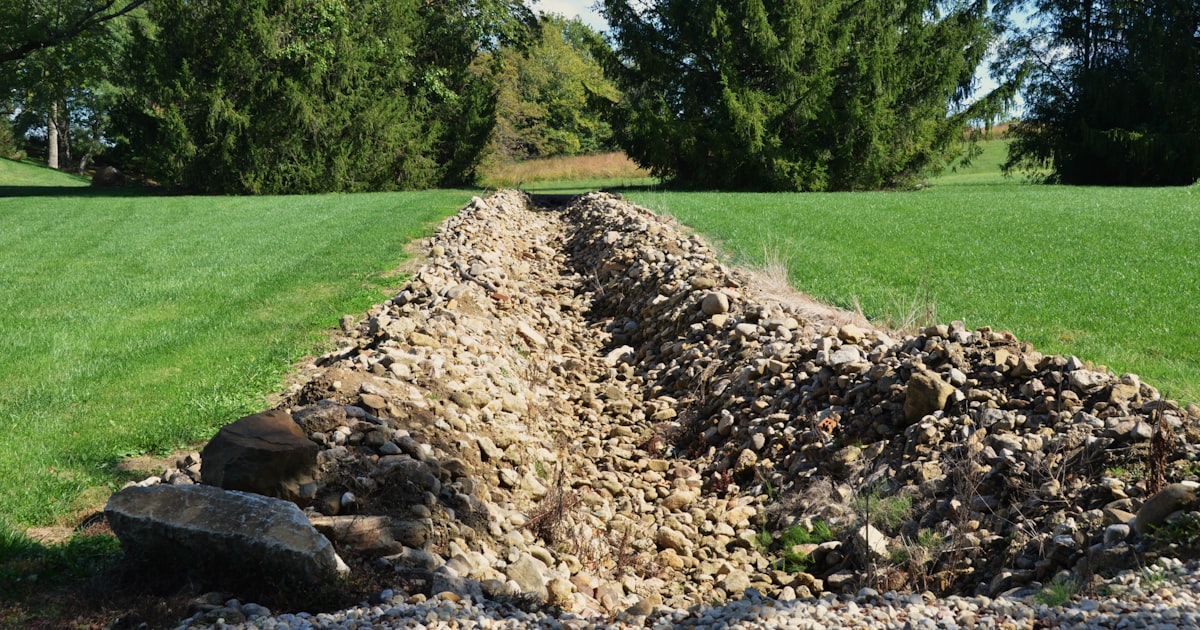
A typical Rocklin drainage trench. Note the gritty tan-orange decomposed granite layer and the abrupt bedrock floor that stops vertical percolation.
TL;DR
Rocklin sits on the Penryn Pluton, a granite bedrock body that intrudes within 1-4 feet of the surface across most of the city. The decomposed granite soil above it drains fast at the top and not at all where it meets the rock. Standard French drains that rely on percolation usually fail in Rocklin -- water has nowhere to go and resurfaces against foundations and hardscape. Working solutions on DG soil are: solid-pipe underground discharge to a daylit downslope or pop-up emitter, gutter systems sized for the full roof load, dry wells only after a percolation test, and trenches kept above the bedrock interface. Expect to hit rock at 12-24 inches in many Rocklin yards. Plan accordingly before pricing any drainage project.
The Penryn Pluton: Why Rocklin Has Granite Where Sacramento Has Dirt
Rocklin's entire identity is built on granite. The historic quarry district off Pacific Street, the Big Gun granite cobbles in the old town core, and the boulders you see breaking through lawns in Stanford Ranch and Whitney Ranch all come from the same source -- the Penryn Pluton. The California Geological Survey maps this granitic body as a Cretaceous-age intrusion that underlies most of Rocklin, Penryn, Loomis, and parts of Lincoln and Newcastle.
For drainage purposes, the geology matters in two ways:
- The bedrock is shallow. Across large parts of Rocklin, the granite is within 1-4 feet of the surface. In some yards it is exposed at grade.
- The bedrock is impermeable. Solid granite has near-zero percolation. Water cannot move through it. It moves on top of it.
- The DG soil above is thin and gritty. Decomposed granite is the weathered upper crust of the pluton. It is sandy, free-draining at the top, and usually only 1-3 feet thick in Rocklin neighborhoods.
Compare that to Sacramento. Most of the Sacramento Valley sits on alluvial sediments deposited by the American and Sacramento rivers. Those sediments are often 20+ feet thick before you hit any consolidated rock, and percolation tests routinely show good vertical drainage through deep sandy and silty profiles. A French drain or dry well in much of Sacramento has somewhere for water to go. In Rocklin, it does not.
Local Field Note
On a recent project off Park Drive, we hit solid Penryn granite at 14 inches. The homeowner had paid for a 4-foot-deep French drain installed by a Sacramento-based contractor a year earlier. The trench was actually 16 inches deep -- they hit rock and stopped. When the rains came, water filled the gravel and had nowhere to go. It backed up against the house and saturated the slab edge. We rebuilt the system as a solid-pipe discharge daylighting at the lot's downslope corner. Same property, same trench length, completely different design.
Why Decomposed Granite Soil Tricks Homeowners Into Bad Drainage Decisions
Pour a bucket of water on bare DG and watch what happens. It disappears in seconds. The soil feels coarse and well-drained, and most homeowners assume that means water will keep moving down through the profile. It does not. The percolation rate at the surface and the percolation rate at depth are two completely different numbers in Rocklin.
Here is the pattern we see on Rocklin properties:
- Rain hits the roof and the surrounding yard.
- Water enters the top 6-12 inches of DG soil quickly.
- It moves downward until it reaches weathered granite or solid bedrock.
- Vertical movement stops. Water spreads laterally along the bedrock interface.
- It resurfaces at the lowest elevation on the property -- usually a foundation, a retaining wall toe, a hardscape edge, or a low spot in the lawn.
That subsurface lateral migration is what creates the classic Rocklin drainage failure: a yard that looks dry on the surface but produces a constant wet spot 30 feet downhill from where the water actually entered the ground. Homeowners chase the symptom instead of the source. The fix is almost always upstream -- catch the water at the gutter and route it past the bedrock interface in a closed pipe.
- Surface runoff on landscape paths and patios
- Shallow planting beds with good grading
- Lots with enough downslope to daylight pipe
- Properties with deeper DG pockets (3+ feet)
- Standard French drains over shallow bedrock
- Dry wells without a percolation test
- Underground downspouts dumping into gravel pits
- Flat lots with no daylight discharge option
The U.S. Geological Survey has documented for decades that fractured and weathered granite zones can carry small amounts of groundwater laterally along the bedrock contact. That is exactly the mechanism creating Rocklin's soggy downhill spots. It is not bad luck or a contractor error -- it is the geology doing what granite always does.
How Gutter Design Changes on Foothill Granite Soil
On granite bedrock, your gutter system has to do more work than it would on a Sacramento alluvial lot. The reason is simple: you cannot rely on the soil to absorb the overflow. Every gallon that lands on your roof has to be captured, transported, and discharged to a place where the geology can actually accept it. Anything that escapes the gutter system becomes a problem you cannot fix at ground level.
That changes three sizing decisions:
1. Gutter capacity
Most Rocklin homes are spec'd with 5-inch K-style gutters by builders. On homes over 2,000 square feet of roof, on lots with shallow bedrock, we routinely upgrade to 6-inch K-style or oversized 7-inch commercial profiles. The bigger trough buys you margin during the atmospheric river events that hit Placer County in December and January. See our 5-inch vs 6-inch gutter sizing guide for the math.
2. Downspout count and diameter
Standard 2x3 downspouts are undersized for Rocklin's storm intensity when you cannot rely on yard absorption. We default to 3x4 downspouts on granite lots and add an extra downspout per long gutter run to keep concentrated flow rates manageable. More downspouts means smaller individual underground lines, which is critical when trench depth is limited by bedrock.
3. Discharge routing
Every downspout has to terminate at a defensible discharge point. On a sloped Rocklin lot that means daylighting to the downslope edge. On a flat lot that means a long solid-pipe run to a pop-up emitter at the property line. There is no "just splash it on the lawn" option that works long-term over shallow bedrock. The water will find its way back to the foundation.
Pro Tip: If your existing downspouts dump within 4 feet of the foundation on a Rocklin lot, that is the single highest-impact thing you can fix this season. Adding a 10-foot underground extension to a daylit pop-up emitter usually costs $300-$600 per downspout and eliminates the most common cause of foundation moisture intrusion on granite soil.
Why French Drains Have to Be Redesigned for Rocklin's Granite Bedrock
A textbook French drain is a perforated pipe in a gravel-filled trench that lets water seep into the surrounding soil along its entire length. That design assumes the soil at the bottom of the trench is permeable. On a Sacramento alluvial lot, that assumption usually holds. On a Rocklin granite lot, it almost never does.
What we actually install in Rocklin is more accurately described as a "subsurface collection and discharge line". It looks like a French drain but functions like a closed gutter network. The design changes are:
- Pitch matters more. Without soil percolation as a backup, the entire system depends on positive slope to a discharge point. We target a minimum 1% fall, ideally 2%, every linear foot of the line.
- Discharge is non-negotiable. The pipe has to go somewhere -- a daylit downslope edge, a pop-up emitter at a low corner, a curb cutout, or a verified dry well. "Trench ends here" is not a discharge plan on granite.
- Filter fabric is mandatory. DG fines migrate into gravel and clog perforated pipe faster than clay does. We wrap the gravel envelope in a non-woven geotextile to extend system life.
- Sometimes you skip the perforation. If the goal is to move roof water from a downspout to a property edge -- not collect groundwater -- we use solid SDR-35 or schedule 40 PVC. No gravel envelope, no filter fabric, just a sealed underground line. It is faster, cheaper, and immune to bedrock issues.
Cost-wise, redesigning a French drain for granite typically adds 15-30% over a standard install because of the extra discharge work and the bedrock obstructions. Our French drain cost guide for Rocklin breaks down the typical price ranges. The good news: the redesign actually works, where the textbook version fails.
- - Lots with verified DG depth of 4+ feet (rare but real)
- - Hillside cuts where you are intercepting subsurface seepage moving along the bedrock
- - Retaining wall back-of-wall drainage (always)
- - Crawl space perimeter drains tied to a sump
- - Properties with documented downhill receiving capacity
How Deep You Can Actually Dig in Rocklin Before You Hit Granite
Bedrock depth varies wildly across Rocklin -- sometimes within a single backyard. The only reliable way to know what you have is to dig a test hole before you commit to a drainage design. Here is a rough guide based on the neighborhoods we work in most often:
| Area | Typical Bedrock Depth | Drainage Difficulty |
|---|---|---|
| Old Town Rocklin / Pacific Street | 6-18 inches | Very high |
| Stanford Ranch | 12-30 inches | High |
| Whitney Ranch | 18-36 inches | Moderate to high |
| Springfield | 12-24 inches | High |
| Sunset West | 18-30 inches | Moderate to high |
| Loomis Basin / Penryn | 6-24 inches (highly variable) | Very high |
| Lower Whitney Oaks (West Roseville border) | 24-48 inches | Moderate |
Field estimates from Rocklin Gutter Guard installations. Always run a test hole before pricing -- single-lot variation can be 12+ inches.
What happens when you hit rock matters as much as where you hit it. Three options:
Stop and re-route. The cheapest option. Keep the trench above the bedrock and use a shallow solid-pipe discharge with positive slope. Works on most lots if you have a daylight option.
Mechanical breaker. Hydraulic hammer attachment on a mini-excavator. Adds $500-$2,000+ to project cost depending on hours required. Used when discharge depth is non-negotiable.
Specialty drilling or controlled blasting. Rare on residential. Required for deep dry wells through solid pluton. Permits, neighbor notification, and significant cost.
The takeaway: design your drainage system around the rock instead of fighting it. A shallow, well-pitched solid-pipe line above the bedrock will outperform a deep trench you wrestled into the granite at three times the cost.
Drainage System Designs That Actually Work on Rocklin Decomposed Granite
After years of installs across the Penryn Pluton, here is what consistently performs on shallow granite lots:
- Solid-pipe underground downspout extensions from each downspout to a daylit pop-up emitter or curb cutout. 3x4 downspouts feeding 4-inch SDR-35 PVC. Trench depth 8-14 inches. Positive slope throughout. The most reliable single drainage upgrade you can make on a Rocklin lot.
- Hybrid French drain plus closed discharge for properties with both surface ponding and roof runoff problems. Perforated pipe in gravel along the wet zone, transitioning to solid pipe past the wet zone, ending at a daylit discharge.
- Catch basin and channel drain network for hardscape areas like driveways, patios, and pool decks where surface water has nowhere to soak in. The DG underneath is irrelevant -- you are moving surface water, not subsurface water.
- Swale plus discharge for larger lots and rural Loomis Basin properties. Shaped surface drainage moving water across the property to a controlled discharge, paired with an underground line for the roof loads.
- Curb cuts to street drainage where allowed by Rocklin Public Works. The simplest, cheapest, and most permanent solution when the property geometry supports it.
For homes near the creeks and ravines that cut through Rocklin -- particularly along Secret Ravine and Antelope Creek -- the design also has to account for high winter water tables and bank seepage. Our Secret Ravine and Antelope Creek drainage guide covers those edge cases in detail.
Hillside lots add another wrinkle. When the bedrock interface tilts, water moves laterally faster and concentrates downslope. We address that in our hillside and sloped lot drainage guide for Placer County.
Common Granite Soil Drainage Mistakes We See in Rocklin
Specifying a French drain without a percolation test
Fix: Run a perc test or at minimum a test hole before pricing. Knowing you have 18 inches of DG over solid rock changes the entire design.
Connecting underground downspout lines to existing gravel pits
Fix: If the original pit was undersized for the geology, the new downspout will overwhelm it instantly. Daylight the discharge instead.
Burying the downspout extension below pop-up emitter level
Fix: Pop-up emitters need positive pressure from above. If the line dips below the emitter, the system airlocks and stops flowing.
Using corrugated black drain pipe on a long run
Fix: DG fines clog corrugated pipe quickly. Use smooth-wall SDR-35 or schedule 40 PVC for every run over 10 feet.
Ignoring tree roots near the proposed trench line
Fix: Oak and valley pine roots follow the bedrock interface looking for water. They will find your trench. Use rigid pipe and inspect annually -- our guide on tree root intrusion in underground drains has the playbook.
Trenching uphill of a retaining wall without a discharge plan
Fix: You will concentrate water behind the wall. Always tie hillside catchment into a closed-pipe line that bypasses the wall.
For more on the root intrusion issue specifically, see our tree roots clogging underground downspout drains in Rocklin guide. On granite lots, root intrusion accelerates because the roots are tracking exactly the same bedrock interface your drain line is following.
What Granite Adds to Drainage Project Costs in Placer County
Drainage work in Rocklin runs higher than equivalent work in Sacramento or Roseville. The cost drivers are bedrock obstructions, longer discharge runs, and the need to size up gutters and downspouts to compensate for limited soil capacity.
| Project Type | Sacramento Valley Range | Rocklin Granite Range |
|---|---|---|
| Single underground downspout extension (10 ft) | $250 - $450 | $300 - $600 |
| Full home underground downspout system (4 downspouts) | $1,200 - $2,500 | $1,800 - $3,500 |
| French drain (50 linear feet) | $2,500 - $5,000 | $3,500 - $7,500 |
| Dry well (verified perc, mid-size) | $1,500 - $3,500 | $2,500 - $6,000+ |
| Bedrock breaker time (per project, when needed) | $0 | $500 - $2,000+ |
Estimated 2026 ranges. Real bids depend on access, slope, lot size, and bedrock conditions. Always verify with an on-site assessment.
The number that matters most is the cost of doing nothing. A foundation repair on a Rocklin lot with chronic drainage failure typically runs $5,000-$25,000 once you account for slab cracking, hairline migration into stucco, and damage to interior finishes. Even at the high end of the granite-adjusted drainage range, fixing the water problem is dramatically cheaper than fixing the structural one. Our water damage cost analysis for Rocklin walks through the full numbers.
Not sure how deep your bedrock is?
We run a free on-site test hole before pricing any drainage project in Rocklin. You will know exactly what you are working with before you spend a dollar.
Schedule a Free Drainage AssessmentGranite Soil Drainage Inspection Checklist for Rocklin Homeowners
Walk your property after the next heavy rain and look for these signs that the geology is fighting your existing drainage system:
- Wet spots that appear 20+ feet downhill from the nearest downspout but never dry out
- Mossy or algae stains on exposed granite outcrops where water sheets across after storms
- Soggy lawn at retaining wall toes, especially walls cut into a hillside
- Standing water at the foundation perimeter even when downspouts appear to be working
- Pop-up emitters that never pop because the line is airlocked or full of fines
- Hairline cracks in concrete walkways tracing the line of an underground drain
- Efflorescence (white mineral staining) on the bottom edge of stucco or block walls
- Gutter overflow during storms despite recent cleaning -- a sizing problem on a granite lot
Any two or more of these signs together usually means the drainage system was designed for the wrong soil profile. The fix is rarely cleaning -- it is redesigning the discharge path so the geology stops working against you. Our clay soil foundation drainage guide covers the inverse problem on the parts of Rocklin that have clay-rich Fiddyment and Alamo series soils instead of DG.
Frequently Asked Questions About Decomposed Granite Drainage in Rocklin
Can you install a French drain in Rocklin's granite soil?
Yes, but the design has to change. On Rocklin properties with DG over shallow Penryn Pluton bedrock, the bottom of a standard French drain trench will not absorb water -- it just hits rock and pools. The fix is to route the perforated pipe to an above-grade pop-up emitter, daylight it on a downslope, tie it into a verified dry well, or convert the system to a closed solid-pipe underground discharge line. A traditional 'dig a trench and let the water seep away' French drain rarely works on shallow granite without modification.
Why is drainage harder in Rocklin than Sacramento?
Sacramento sits on deep alluvial valley sediments that percolate water reasonably well in most areas. Rocklin sits at the western edge of the Sierra Nevada foothills, directly above the Penryn Pluton -- a granitic bedrock body that intrudes within 1-4 feet of the surface across most of the city. The decomposed granite layer above is shallow and underlain by impermeable rock, so water moves laterally instead of percolating downward. Every drainage system in Rocklin has to account for that.
Does decomposed granite soil drain well?
At the surface, yes. Through the full profile, no. DG drains fast in the top few inches and feels gritty and well-aerated -- but below 1-3 feet you usually hit weathered or solid granite, and water cannot keep moving down. It spreads sideways along the bedrock interface and resurfaces at the lowest point on the property. DG soil drains well at the top and badly at the bottom.
How deep can you dig for drainage in Rocklin?
On most Rocklin lots you can hand-dig or mini-excavate through the DG layer down to 18-36 inches before hitting weathered or solid granite. After that, you need a hydraulic breaker, which dramatically raises cost. We routinely encounter homes in Stanford Ranch, Whitney Ranch, Springfield, and the Loomis Basin where bedrock starts at 12-24 inches. Always assume shallow bedrock when planning a French drain or underground downspout in Rocklin and verify with a test hole before pricing the job.
What is the Penryn Pluton and how does it affect Rocklin drainage?
The Penryn Pluton is a Cretaceous-age granitic intrusion underlying most of Rocklin, Penryn, and Loomis. It is the same granite that built Rocklin's historic quarry industry. The pluton sits at or near the surface across large parts of the city, which is why granite outcrops show up in yards and parks. From a drainage perspective, the pluton acts as an impermeable floor under your property -- water cannot percolate through it. Drainage systems either move water above the bedrock to a discharge point or punch through it.
Can I use a dry well on decomposed granite soil in Rocklin?
Sometimes. A dry well only works if the receiving soil under it can actually absorb the discharge. On shallow Rocklin bedrock that often is not the case. Two scenarios where dry wells do work: lots with deeper DG pockets where the well can sit in a permeable seam, or cases where a contractor breaks through the bedrock cap into a more fractured zone underneath. Always run a percolation test before specifying a dry well in Rocklin.
Drainage Built for Rocklin's Granite, Not Sacramento's Dirt
Rocklin Gutter Guard installs gutter systems, underground downspout extensions, and French drains designed specifically for decomposed granite soil and shallow Penryn Pluton bedrock. We test the geology before we trench, size the system to the actual roof load, and warranty the discharge path. Free on-site assessments across Rocklin, Loomis, Penryn, Newcastle, and west Roseville.