
Flat Roof Gutter and Scupper Drainage Solutions for Placer County Homes and Commercial Buildings
Flat roof gutter drainage in Placer County comes down to three options: scuppers through parapet walls, interior roof drains, or conventional edge-mounted gutters. The right system depends on whether your building has parapets, how large the roof area is, and whether you need to meet commercial code requirements.
Rocklin and surrounding Placer County communities see concentrated rainfall between November and March, with atmospheric river events delivering 2+ inches per hour. On pitched roofs, gravity handles the work. On flat roofs, poor drainage turns into standing water within hours — and standing water on a flat roof is the fastest path to structural damage, membrane failure, and leaks into the building below.
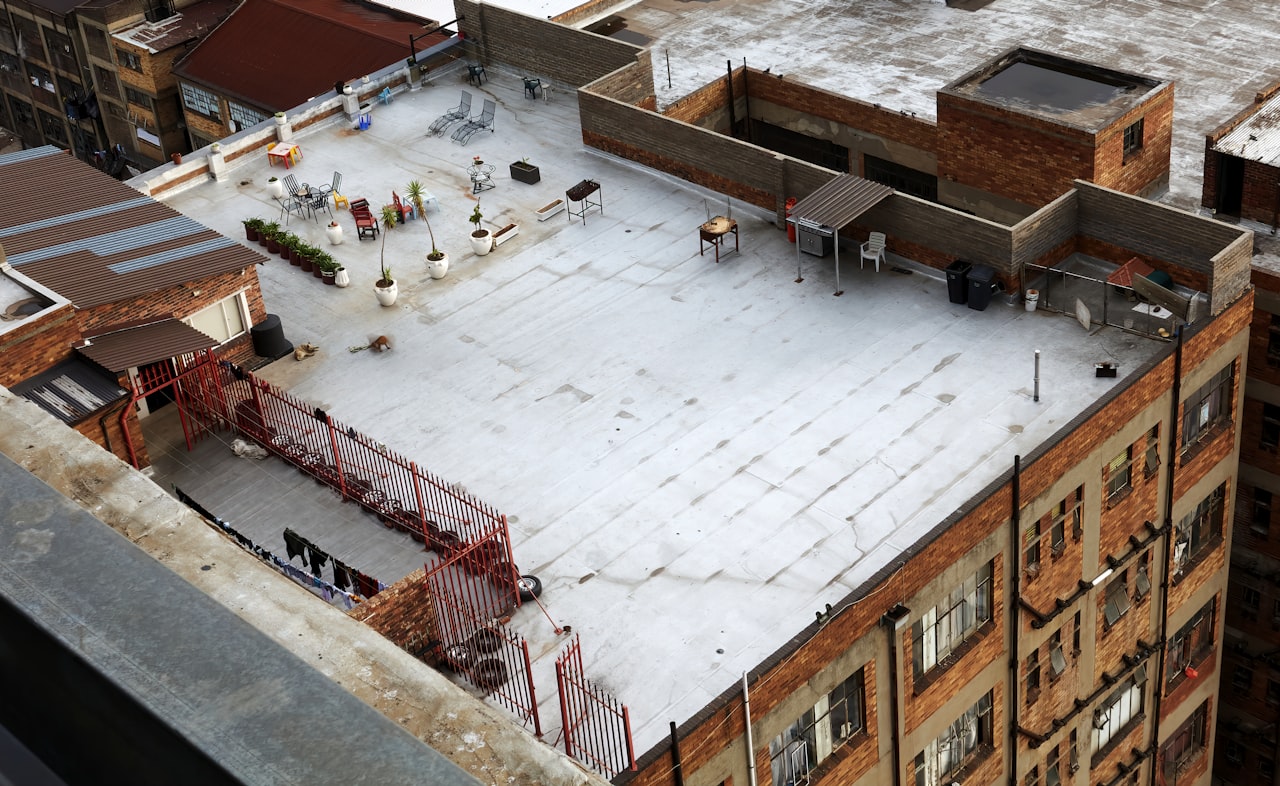
Flat roofs require engineered drainage systems to prevent ponding water and structural damage.
TL;DR
Flat roofs drain via scuppers (openings in parapet walls), interior drains (connected to underground pipes), or edge-mounted gutters. Scuppers are the simplest and lowest-maintenance option for buildings with parapets — $300-$800 per scupper installed. Interior drains handle the largest volumes but cost $1,500-$4,000 per drain and require underground piping. Conventional gutters work for residential flat roofs without parapets at $8-$15 per linear foot. Placer County code (2022 CBC) requires both primary and secondary overflow drainage on all flat roofs. Undersized or clogged flat roof drainage is the #1 cause of commercial roof failures in the Sacramento Valley.
Why Flat Roof Drainage Is Different from Pitched Roof Systems
A pitched roof sheds water by gravity. A 6/12 slope moves water off the surface at roughly 3 feet per second. Flat roofs — which actually have a slight slope of 1/4 inch per foot minimum — move water roughly 10 times slower. That speed difference means flat roofs hold more water for longer periods, creating weight loads that pitched roofs never experience.
One inch of standing water across a 2,000 square foot flat roof weighs approximately 10,400 pounds. During a Placer County atmospheric river event delivering 2 inches per hour, that roof needs to drain 2,500 gallons per hour just to keep up. If drainage capacity falls short, water accumulates, and the sizing math changes entirely compared to a standard pitched roof.
Water Weight on a 2,000 sq ft Flat Roof
According to the National Roofing Contractors Association (NRCA), ponding water is the leading cause of premature flat roof failure. The 2022 California Building Code (CBC Section 1502.1) defines ponding as water that remains on a roof surface 48 hours after the last rainfall — and requires that all flat roof drainage systems prevent it.
Key stat: The NRCA estimates that 40% of all commercial roofing callbacks are drainage-related, and improper flat roof drainage is the #1 contributor to early membrane failure (National Roofing Contractors Association).
Three Flat Roof Drainage Methods: Scuppers, Interior Drains, and Gutters
Every flat roof drainage system falls into one of three categories. Each has distinct advantages depending on roof size, building type, and whether parapets are present.
Scupper Drains: How They Work and When to Use Them
A scupper is an opening cut through the parapet wall (or built into the roof edge) that lets water drain off the roof by gravity. Water flows across the roof surface toward the low point, passes through the scupper opening, and either free-falls to the ground or enters a downspout connected to a conductor head at the scupper outlet.
Scuppers are the simplest flat roof drainage option. No pumps, no underground piping, no moving parts. They work purely by gravity and require the least maintenance of any flat roof drainage method.
- Lowest maintenance — no moving parts to fail
- Handles debris better than interior drains
- Cost-effective: $300-$800 per scupper installed
- Visible and easy to inspect from ground level
- Requires parapet walls or raised roof edges
- Limited capacity per opening (sized individually)
- Can erode soil/landscaping if no downspout connected
- Parapet penetration requires proper flashing
In Placer County, scuppers are the most common drainage method for commercial buildings under 10,000 square feet with parapet walls. They are also increasingly used on residential flat-roof additions, ADU conversions, and modern-style homes in Rocklin, Roseville, and Lincoln.
Interior Roof Drains: High Capacity for Large Roofs
Interior drains sit at low points on the roof surface and connect to underground piping that routes water to the storm drain system. They resemble floor drains — a strainer cover sits flush with the roof surface, and water enters from all directions.
This method handles the highest water volumes, which is why big-box retail, warehouses, and multi-story commercial buildings in Placer County rely on them. A single 4-inch interior drain handles approximately 175 gallons per minute — roughly 3x the capacity of a standard scupper.
- Best for: Commercial buildings over 5,000 sq ft, multi-level structures, roofs with complex geometry
- Cost: $1,500-$4,000 per drain installed (includes underground piping)
- Maintenance: Strainers clog with leaves, especially near trees — requires regular clearing
The main drawback: when interior drains clog, the problem is invisible from outside the building until water is already deep enough to cause damage. Regular inspection is critical, especially during Placer County's November-March wet season.
Edge-Mounted Gutters: The Residential Standard
Conventional gutters mounted to the roof edge or fascia board work on flat roofs the same way they work on pitched roofs — water flows off the roof edge into the trough and down through downspouts. The key difference: flat roofs deliver water to gutters much more slowly, so oversizing is less of a concern than with steep-pitch roofs.
Edge gutters are the go-to option for residential flat roofs without parapets. They are familiar to every contractor, use standard materials, and connect to the same seamless gutter systems used on pitched roofs. However, they cannot be used on buildings with parapet walls that extend above the roof edge.
- Best for: Residential flat roofs, carports, patio covers, ADUs without parapet walls
- Cost: $8-$15 per linear foot installed (standard 5" aluminum)
- Limitation: Not usable with parapet walls; requires exposed roof edge
Drainage Method Comparison by Building Type
How to Size Scuppers for Placer County Rainfall
Scupper sizing is governed by the 2022 California Plumbing Code (CPC), which follows the International Plumbing Code (IPC) drainage calculations. The process works the same as gutter sizing for pitched roofs but with different input assumptions for slope and flow rate.
Scupper Sizing Steps
- 1Calculate roof drainage area. Measure the total flat roof area draining to each scupper. For rectangular roofs, divide the total area by the number of planned scupper locations.
- 2Apply Placer County rainfall intensity. The design rainfall rate for Placer County is 2 inches per hour (moderate commercial) to 4 inches per hour (critical drainage areas). Residential typically uses 2 in/hr. Multiply the drainage area by the rainfall rate.
- 3Size the scupper opening. A standard 4-inch-wide by 4-inch-tall scupper drains approximately 60 GPM at 2 inches of head (water depth at the scupper). A 6-inch by 6-inch scupper handles roughly 135 GPM. Match the required flow rate to the scupper capacity.
- 4Add secondary overflow scuppers. California code requires a secondary (overflow) drainage system sized to handle 100% of the primary system's capacity. Overflow scuppers are typically set 2 inches above the primary scupper level.
Pro Tip
Overflow scuppers should be visible from ground level. When water exits an overflow scupper, it tells you the primary system is overwhelmed or clogged — an early warning sign before water enters the building. Position overflow scuppers on the building's most visible side so problems are caught early.
Scupper Capacity Reference Table
| Scupper Size (W x H) | Flow at 2" Head | Max Roof Area (2 in/hr) | Typical Use |
|---|---|---|---|
| 4" x 4" | ~60 GPM | ~1,200 sq ft | Residential, small additions |
| 6" x 4" | ~90 GPM | ~1,800 sq ft | Residential, ADUs |
| 6" x 6" | ~135 GPM | ~2,700 sq ft | Small commercial |
| 8" x 6" | ~240 GPM | ~4,800 sq ft | Medium commercial |
| 12" x 6" | ~360 GPM | ~7,200 sq ft | Large commercial, warehouse |
These are guideline figures. Your engineer or contractor should calculate exact sizing based on the specific roof geometry, drainage path lengths, and head pressure at each scupper location.
Placer County Building Code Requirements for Flat Roof Drainage
Placer County follows the 2022 California Building Code (CBC) and 2022 California Plumbing Code (CPC) for all drainage requirements. If your property falls within a WUI fire hazard zone, additional material restrictions apply to gutter and scupper components.
Primary + Secondary Drainage Required
Every flat roof must have both a primary drainage system and a secondary (overflow) system. The secondary system must handle 100% of the design storm capacity independently (CBC Section 1503.4).
Minimum Roof Slope: 1/4 inch per foot
All flat roofs must slope toward drainage points at a minimum of 1/4 inch per foot. This applies to the structural deck, tapered insulation, or a combination. Zero-slope (dead flat) roofs are not code-compliant.
Overflow Scupper Height
Secondary overflow scuppers must be set at a height that prevents water from exceeding the structural load capacity of the roof. Typically 2 inches above the primary scupper invert.
Drainage to Approved Discharge Point
Water from scuppers and drains must discharge to grade, a storm drain, or an approved retention system. Discharge onto adjacent property or public walkways is prohibited.
Fire Zone Material Restrictions
Properties in Placer County WUI zones require non-combustible gutter and scupper materials. Vinyl and PVC components are not permitted. Aluminum, steel, and copper all qualify.
For ADU and patio cover projects in Rocklin, the city's building department requires a drainage plan as part of the permit application. This plan must show scupper or drain locations, pipe routing, and the discharge point. Permits are typically reviewed within 2-3 weeks.
Need Help Sizing Flat Roof Drainage?
We evaluate flat roof drainage systems for homes and commercial buildings across Placer County. Free on-site assessment includes scupper sizing, gutter recommendations, and a written estimate.
Get a Free Drainage AssessmentFlat Roof Drainage Cost Comparison for Placer County (2026)
Costs vary based on roof area, building height, and existing infrastructure. These ranges are based on typical Placer County residential and commercial projects. For conventional gutter installation pricing, see our dedicated cost guide.
Installation Cost per Drainage Point
For a typical 1,500 square foot residential flat roof in Rocklin, a complete scupper system (3 primary + 3 overflow) runs $2,500-$5,500 installed. A comparable edge gutter system for the same roof costs $1,200-$2,250 (about 150 linear feet) plus $1,800-$3,000 for gutter guard installation at $12-$20 per linear foot.
Commercial buildings pay more due to access requirements (lift equipment), larger scupper sizes, and the need for engineered drawings. A 5,000 sq ft commercial flat roof with interior drains typically runs $8,000-$15,000 for the complete drainage system.
Five Common Flat Roof Drainage Problems in Placer County
We see the same flat roof drainage failures across Rocklin, Roseville, and Lincoln properties. Most are preventable with proper initial design or routine maintenance.
Scuppers Too Small for Atmospheric River Events
Many flat roofs installed before 2015 were designed for 1 inch/hour rainfall intensity. Placer County atmospheric river events regularly exceed 2 inches/hour. When scuppers are undersized, water backs up faster than it can drain, and the overflow scuppers activate during every moderate storm -- not just extreme events.
Fix: Upsize scuppers to handle 2 in/hr minimum. Add additional scupper locations if the existing openings cannot be enlarged without compromising the parapet structure.
Clogged Scuppers from Leaf and Debris Buildup
Scupper openings collect leaves, pine needles, and roofing granules at the parapet base. Even partial blockage cuts flow capacity dramatically. Rocklin homes near oak and pine canopy are particularly vulnerable during fall.
Fix: Install scupper guards (wire strainers) and clear debris monthly during October-March. Consider gutter guards on the collector gutters below scupper outlets.
Ponding from Inadequate Roof Slope
Flat roofs that settle over time, or were built with insufficient slope, develop low spots where water ponds. According to the NRCA, water should not remain on a roof surface more than 48 hours after rain. Placer County's clay soil can contribute to uneven settling of the building structure itself.
Fix: Apply tapered insulation or a tapered fill system to re-establish positive slope. This is a roofing contractor job, not a gutter job -- but the drainage system design must account for the corrected slope.
No Conductor Head on Scupper Outlets
Scuppers without conductor heads (the sheet metal funnel connecting the scupper to the downspout) dump water freely against the building wall. This causes staining, efflorescence on masonry, and accelerated deterioration of the wall surface below the scupper.
Fix: Install conductor heads at every scupper outlet and connect to properly sized downspouts routed to grade or the underground drainage system.
Underground Drain Lines Damaged by Tree Roots
Interior roof drains connected to underground piping are vulnerable to root intrusion, particularly from Rocklin's established oak trees. Roots seek the moisture in drain lines and can crack or block pipes entirely.
Fix: Annual camera inspection of underground drain lines. See our guide to tree roots clogging underground downspout drains for detection and prevention methods.
For problem #5, our full guide on tree root intrusion in underground drains covers detection methods, repair options, and root barrier installation for Rocklin properties.
Flat Roof Drainage Maintenance Schedule for Placer County
Flat roof drainage systems need more frequent attention than pitched roof gutters because debris sits on the roof surface rather than washing off. The following schedule is based on Placer County's climate patterns and our experience servicing flat roofs across the region.
Annual Maintenance Timeline
- Monthly (Oct-Mar): Clear all scupper openings and drain strainers of leaves, pine needles, and debris
- Quarterly: Inspect roof membrane around drain penetrations and scupper flashing for cracks or lifting
- Twice yearly (spring + fall): Full roof drainage test — run water across the surface and time how quickly it clears
- After every major storm: Check for ponding, verify overflow scuppers did not activate, inspect for new low spots
- Annually: Camera inspection of underground drain lines (interior drain systems only)
For buildings with edge-mounted gutters on flat roofs, follow the same maintenance schedule outlined in our spring gutter maintenance checklist and seasonal maintenance timing guide.
Real example: A Roseville strip mall on Pacific Street had three 4-inch scuppers serving a 4,500 sq ft flat roof — undersized by roughly 40% for modern atmospheric river rainfall rates. During a January 2024 storm, all three scuppers were overwhelmed simultaneously. Water rose above the overflow scuppers and entered through a rooftop HVAC unit, causing ceiling damage to two tenant spaces. Total repair cost exceeded $18,000. Upgrading all six scuppers (3 primary + 3 overflow) to 8-inch openings cost $4,200 — a fraction of the damage bill.
Residential vs Commercial Flat Roof Drainage in Placer County
The drainage principles are the same, but code requirements, sizing, and maintenance responsibilities differ significantly between residential and commercial properties.
| Factor | Residential | Commercial |
|---|---|---|
| Typical roof size | 500-2,500 sq ft | 2,000-50,000+ sq ft |
| Most common method | Edge gutters or scuppers | Interior drains + scupper overflow |
| Permit required | Yes (new construction/ADU) | Yes (always) |
| Engineer stamp needed | Rarely | Usually (structural + drainage) |
| Design rainfall rate | 2 in/hr | 2-4 in/hr (risk-based) |
| Maintenance responsibility | Homeowner | Property manager/HOA/tenant (per lease) |
| Typical total cost | $1,500-$5,500 | $5,000-$25,000+ |
Commercial property owners and managers in Placer County should also review our commercial and HOA gutter maintenance guide for operational schedules, vendor management, and liability considerations specific to multi-tenant buildings.
Frequently Asked Questions: Flat Roof Drainage
Scuppers are openings cut through the parapet wall or roof edge that allow water to drain off a flat roof by gravity. Water flows across the roof surface toward the scupper, passes through the opening, and either free-falls to the ground or enters a downspout connected to the scupper outlet. Most scuppers are 4-6 inches wide and positioned at the lowest points of the roof. They require zero electricity and have no moving parts, making them the lowest-maintenance flat roof drainage option.
Not always. Flat roofs can use three drainage methods: scuppers through parapet walls, interior roof drains connected to underground piping, or conventional gutters mounted at the roof edge. Gutters are the most common choice for residential flat roofs without parapets, while scuppers and interior drains are standard on commercial buildings. Placer County Building Code requires every flat roof to have a primary and secondary (overflow) drainage system regardless of which method you choose.
For most residential flat roofs in Placer County, scuppers paired with collector gutters provide the best balance of cost, reliability, and maintenance. Commercial buildings over 5,000 square feet typically benefit from interior roof drains with secondary scupper overflow. The best choice depends on roof size, parapet presence, and local drainage requirements. Placer County follows the 2022 California Building Code (CBC), which requires positive drainage with a minimum slope of 1/4 inch per foot toward drains.
Scupper installation in Placer County typically costs $300-$800 per scupper for residential applications, including the parapet opening, sheet metal scupper box, and connection to a downspout. Commercial scuppers with larger openings and conductor heads run $500-$1,500 each. A typical residential flat roof needs 2-4 scuppers depending on roof area. Total project cost for a complete scupper drainage system on a 1,500 sq ft flat roof runs $1,500-$4,000 installed.
Ponding water on flat roofs in Rocklin is caused by insufficient drainage capacity, clogged scuppers or drains, inadequate roof slope (less than 1/4 inch per foot), structural deflection of the roof deck, or failed roofing membrane that creates low spots. Rocklin's clay soil conditions also contribute — when underground drain lines connect to the storm system, soil movement can shift pipe connections and create backflow. Water that remains on a flat roof for more than 48 hours after rain is classified as ponding and requires correction.
Flat Roof Drainage Problems? Get a Free Assessment
We inspect scuppers, interior drains, and gutter systems on flat roofs across Placer County. Whether you need a new drainage system or repairs to an existing one, you will get a written assessment and estimate at no cost. Serving Rocklin, Roseville, Lincoln, Granite Bay, and all of Placer County.