
Roof valley drainage
How Close Should a Downspout Be to a Roof Valley?
Answer first: put drainage capacity near concentrated valley flow, but do not choose a distance by rule of thumb alone.
If water fills the gutter before reaching the current outlet, a closer and often larger downspout can fix the bottleneck. If water shoots over an empty gutter, move to flow control instead—a new outlet cannot catch water that never enters the trough.
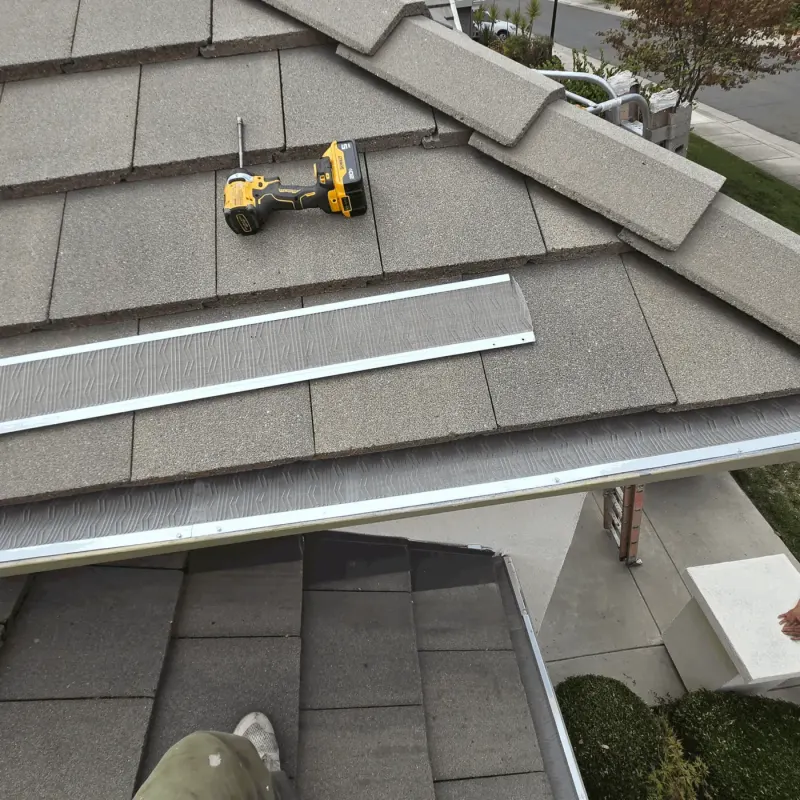
Outlet sizing, valley placement, and safe discharge routing.
Roseville downspout installation & repairCapacity upgrades for long runs and complex rooflines.
First Determine Which Kind of Overflow You Have
Watch from the ground during rain or reproduce the issue safely with a hose in dry weather. If the gutter fills from the valley toward the outlet, evacuation is too slow. If a narrow stream leaps over the outer lip while the gutter stays mostly empty, velocity and entry angle are the problem.
Our main roof valley gutter overflow guide compares all five fix categories. For an inside miter, use the more specific inside-corner overflow diagnostic.
Five Inputs That Decide Downspout Placement
1. Contributing roof area
Trace both planes feeding the valley, not only the eave directly above the gutter. A short valley between large planes can deliver more water than a long straight roof edge.
2. Roof pitch and valley velocity
Steeper planes deliver water faster. That may require a splash guard at the entry point as well as a closer outlet after water enters the gutter.
3. Gutter size and slope
A 6-inch trough offers more temporary storage, but it still needs enough fall toward a capable outlet. A flat or back-pitched run will overflow regardless of downspout size.
4. Outlet and downspout dimensions
A 3x4-inch downspout is often the practical choice near oak debris and concentrated flow because its larger opening is harder to bridge with leaves than a 2x3-inch outlet.
5. Safe discharge location
Do not add capacity at the roof and dump that extra water beside the slab, onto a walkway, toward a neighbor, or onto an erodible slope. The extension, solid drain line, or approved surface route is part of the design.
A Practical Decision Sequence
- Clear the gutter and flush the existing outlet so debris does not distort the test.
- Confirm the gutter slopes continuously toward the outlet without a low spot at the valley.
- Observe whether the failure is overshoot, backup, or a leaking seam.
- Calculate the roof area feeding that run and size the gutter, outlet, and downspout as one system.
- Choose a discharge route before cutting the new outlet, then hose-test the completed system.
When a New Downspout Is Not the Answer
Do not add an outlet just because the overflow appears near a valley. A splash guard is usually the simpler fix when water overshoots a clear, mostly empty gutter. A failed miter must be repaired when water leaks through the joint. A severely undersized run may need 6-inch gutter rather than several outlets crowded into a short elevation.
Gutter guards solve debris entry, not hydraulic capacity. They can support a complete fix by keeping the new outlet open, but the guard profile and valley transition must still admit intense rain.
Roof Valley Downspout FAQ
How close should a downspout be to a roof valley?
There is no universal distance, but a severe valley usually benefits from an outlet in the same short gutter section rather than forcing concentrated water around a corner or along a long run. A contractor should calculate contributing roof area, pitch, gutter size and outlet capacity before choosing the exact location.
Will adding a downspout stop roof valley overflow?
It will help when the gutter fills and backs up because the existing outlet is too far away, too small or obstructed. It will not stop water that overshoots a nearly empty gutter at high speed; that condition needs a splash guard, diverter or redesigned valley transition.
Is a 3x4 downspout better near a roof valley?
A 3x4-inch downspout provides a larger opening and is less vulnerable to leaf bridging than a standard 2x3-inch outlet. It is commonly paired with 6-inch gutters or high-volume valley sections, provided the discharge path can safely accept the additional flow.