
Short-Term Rental Gutter Maintenance in Placer County: Airbnb & VRBO Owner's Playbook for Auburn, Meadow Vista & Foothill Cabins
Short-term rental gutter maintenance in Placer County runs on a different cadence than owner-occupied homes. High guest turnover, foothill pine and cedar debris, AB 3074 Zone 0 defensible space rules, and transient occupancy tax overlays combine into a maintenance schedule that most Airbnb and VRBO hosts underbuild. A cabin in Auburn, Meadow Vista, or Foresthill rented 180 nights a year under towering ponderosa pines does not survive a twice-annual cleaning schedule -- the gutters are packed by August.
This playbook covers the operational reality: quarterly inspection protocols tied to turnover windows, defensible space compliance for high-occupancy properties, guest safety liability around ice and overflow, cost benchmarks for STR-focused service contracts, and documentation standards that protect your insurance binder and platform status.
Running an Airbnb or VRBO in the Placer County foothills? Request a quarterly STR maintenance quote or review our Auburn & Loomis foothill gutter guide.
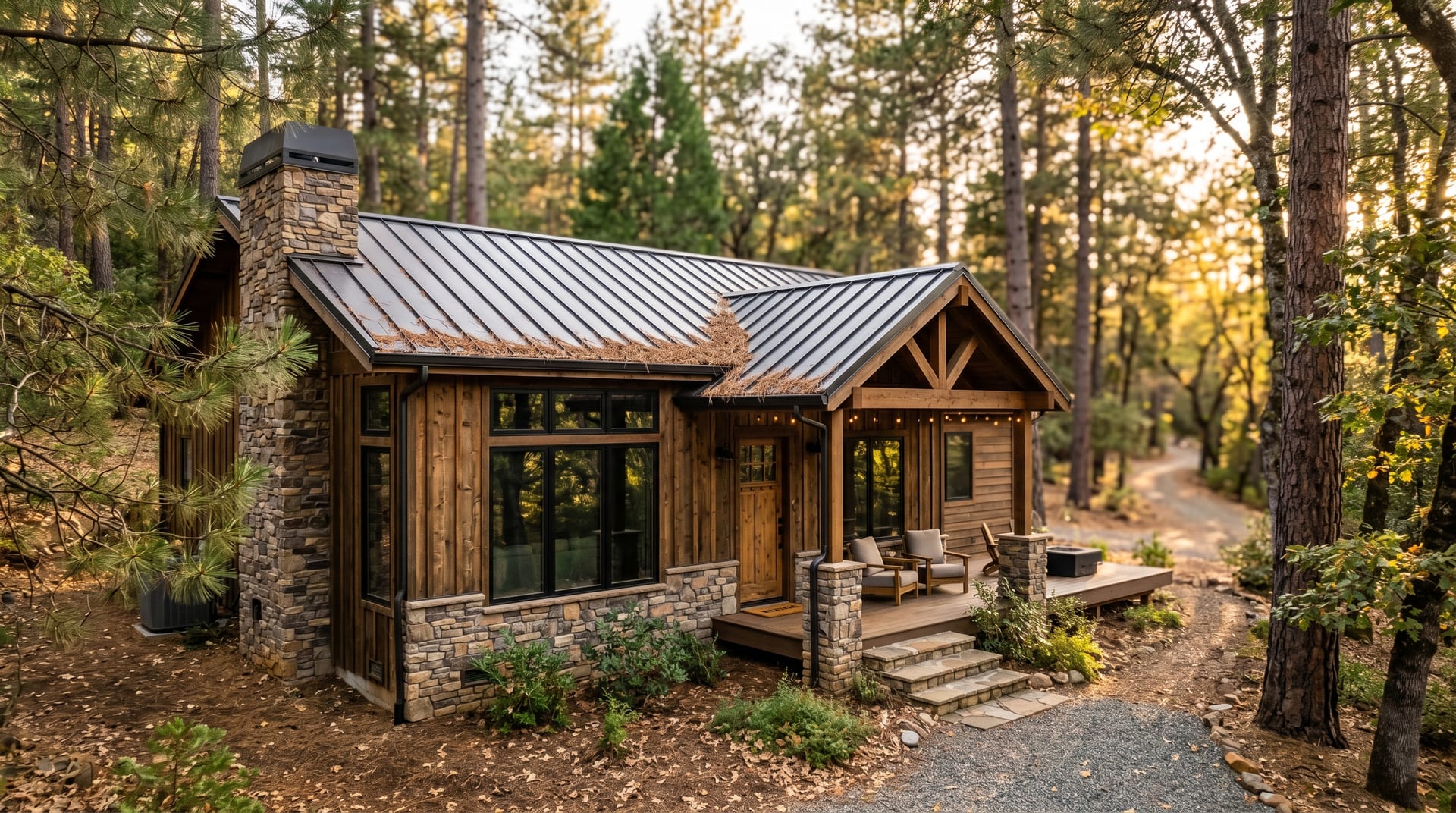
Placer County foothill STRs sit in heavy conifer debris zones and carry fire-code and guest-safety obligations that valley-floor rentals do not face.
TL;DR
Placer County STR hosts should plan four gutter service visits per year for foothill properties (Auburn, Meadow Vista, Foresthill, Colfax, Weimar) and two visits per year for valley-floor rentals (Rocklin, Loomis, Lincoln, Roseville). Quarterly inspections protect against guest safety claims, keep AB 3074 Zone 0 defensible space compliant, satisfy insurance carrier documentation requirements, and preserve your five-star review cadence. Typical annual spend runs $720 to $1,280 for a 2,000 to 2,800 sq ft foothill STR on a service contract. Skipping this category is the single most common maintenance gap we see on rural Placer County rentals -- and it is the one most likely to trigger a denied claim or a bad review cycle.
Why Short-Term Rental Gutter Maintenance Is Different From Owner-Occupied Homes
An owner-occupied Placer County home sees its gutters every day. The owner walks the perimeter, notices a sagging section, spots overflow staining on the fascia, and catches problems early. A short-term rental does not get that daily feedback loop. The owner is often 50 miles away in Sacramento, Roseville, or the Bay Area. The guests do not report drainage issues -- they report strong coffee and a broken hot tub.
That observation gap is the single biggest reason STR gutters fail catastrophically rather than gradually. A pine needle mat that would take 12 months to form on an owner-occupied home can pack a foothill STR gutter in 8 to 10 weeks during fall drop. Overflow saturates the fascia, rot sets in behind the wood trim, the gutter loses its hanger grip, and the first visible symptom is a gutter section hanging off the roof in front of a guest's Instagram camera.
STR vs. Owner-Occupied Gutter Observation Frequency (Placer County)
Compounding the observation gap: STR homes accumulate outdoor wear faster than owner-occupied properties. More foot traffic on decks, more patio umbrella anchoring, more fireplace use, more hot tub evaporation. All of it strains downspout drainage and deck substructures below the roof edge. Foothill cabins in Placer County also tend to sit on steeper lots with tighter tree canopy, which amplifies debris drop.
The result: an STR needs a gutter program that substitutes for daily owner observation. Four specific obligations drive the cadence.
- Guest safety and premises liability: Overflow at walkway entrances, ice buildup at step risers, and fallen gutter sections are premises-liability events that STR-endorsed insurance policies treat under strict documentation rules.
- Fire-code compliance: AB 3074 Zone 0 defensible space and the 2026 California Wildland-Urban Interface Code both attach to the property regardless of occupancy type. STRs in Fire Hazard Severity Zones carry the same obligations as any other home.
- Platform reputation management: Visible maintenance deferrals -- peeling paint, rusted downspouts, stained fascia, sagging gutters -- translate directly into lower nightly rates and lower review scores on Airbnb and VRBO.
- Capital protection: Foothill STRs tend to be higher-value structures. Fascia rot, deck substructure damage, and foundation drainage failures compound fast under heavy Placer County storm sequences. See our atmospheric river prep guide for the weather context.
Placer County STR Micro-Markets and Their Gutter Risk Profiles
Placer County's STR landscape splits into three elevation bands with meaningfully different maintenance profiles. Knowing which band your property sits in drives the service cadence, the material recommendations, and the insurance documentation framework.
Valley floor (200-800 ft)
Rocklin, Loomis, Lincoln, Roseville. Mostly suburban event-stay and corporate relocation STRs. Oak and liquidambar debris dominate.
Cadence: 2-3 cleanings/yr
FHSZ exposure: Moderate in parts
Key risk: Oak tassel matting
Lower foothills (800-2,500 ft)
Auburn, Penryn, Newcastle, Loomis rural, Meadow Vista. Mixed oak and pine. Heaviest STR booking density in the county outside Tahoe.
Cadence: 4 cleanings/yr
FHSZ exposure: High / Very High common
Key risk: Pine needle packing + oak drop
Upper foothills (2,500-5,000 ft)
Foresthill, Weimar, Colfax, Applegate, Gold Run. Conifer-dominant. Winter snow load and ice dam risk on upper end.
Cadence: 4-6 cleanings/yr
FHSZ exposure: Very High standard
Key risk: Cedar / juniper scale + snow load
Notable Placer County STR Submarkets
- Auburn (historic old town):Craftsman and Victorian conversions. Half-round and K-style gutters on complex rooflines. High oak canopy exposure.
- Meadow Vista:Custom cabins and ranchettes, mixed conifer and oak. Heavy spring pine pollen plus fall needle drop double cadence.
- Foresthill / Weimar:Remote cabins, often with deep snow loads on upper elevations. Gutter aprons and snow guards often retrofit-needed.
- Colfax / Gold Run:Historic mining-era structures plus newer builds. Tight tree canopy and steep lot drainage compound risk.
- Penryn / Newcastle:Mature oak, vineyard-adjacent, heavy leaf load and tassel drop. Lower fire-zone intensity than upper foothills.
For a deeper elevation-by-elevation breakdown, see the Penryn, Newcastle & Meadow Vista gutter guide or the Auburn & Loomis foothill guide.
The Quarterly STR Gutter Inspection Protocol
Foothill STR hosts should anchor the service cadence to four natural shoulder dates in the Placer County calendar. Each aligns with a specific debris profile and a slow booking window, so turnover disruption stays minimal.
Recommended Quarterly STR Service Calendar
What Each Visit Should Cover
A quarterly STR cleaning is not just a debris scoop. It is an inspection pass with a photographic deliverable that supports insurance, fire-code, and platform documentation. A good STR service visit produces a written report, not just a clean gutter.
- 1
Full gutter debris removal to bare metal
Hand-scoop heavier debris, follow with a blower or vacuum pass, then rinse to confirm flow. Pine needle mats, oak tassels, and cedar scale each demand a different removal technique.
- 2
Downspout flow test on every leader
Water-tested downspouts, with extensions verified to daylight or to an underground system. Flag any sluggish drainage before it manifests as overflow during the next storm.
- 3
Hanger, seam, and miter inspection
Walk every linear foot, check hanger spacing, look for rust streaks at seams, and test miter joints for movement. Log any issues with photo evidence and a repair recommendation.
- 4
Fascia and soffit inspection
Probe for soft spots, look for paint bubbling or stain patterns, photograph any discoloration. Placer County fascia damage from deferred gutter work is the single most expensive STR surprise.
- 5
Guard and screen inspection
Confirm micro-mesh is intact, no dips from debris weight, no lifted seams. Plastic screens are not Zone 0 compliant -- flag any that are still in place.
- 6
Roof-edge debris clearance (Zone 0)
Verify the 0-to-5-foot envelope is free of bark mulch, stored firewood, woody shrubs, and combustible material. Photograph for the defensible space file.
- 7
Guest-visible deck and patio drainage check
Walk the deck and patio perimeter. Any pooling, mud splatter, or visible overflow staining where guests place chairs or hot tub steps is a five-star review threat.
- 8
Written report with photos and date stamp
One-page PDF. Lists completed work, flagged issues, recommended repairs, and timestamped photos. Filed in a shared folder so your insurance broker and co-host can access on demand.
Pro Tip
Schedule the quarterly visit during a deliberate turnover gap -- a Monday-to-Wednesday window between back-to-back weekend bookings is ideal. Block the property in the platform calendar 24 hours before and 12 hours after to give the service crew roof access without a guest present. Roof work during an occupied stay creates liability exposure and review risk that is not worth saving a vacancy day.
AB 3074 Zone 0 Defensible Space for High-Turnover Rentals
AB 3074 does not distinguish between owner-occupied and short-term rental occupancy. If the property sits in a Placer County Fire Hazard Severity Zone, the 0-to-5-foot ember-resistant envelope applies. For STR hosts specifically, three dynamics make compliance harder and more important at the same time.
First, guest behavior undermines Zone 0. Guests bring firewood, stack it against the cabin wall, leave patio cushions out overnight, and rearrange planters. Any of those can put combustible material inside the 5-foot envelope between inspections. Second, absentee ownership means the Zone 0 check is not happening daily. Third, insurance carriers writing STR-endorsed policies in Placer County now treat defensible space documentation as a condition of coverage.
STR-Specific Zone 0 Compliance Gaps
What to Include in Your STR Guest Instructions
A one-page guest fire-safety guide, posted at the property and attached to the booking confirmation email, is the simplest and most effective tool for keeping Zone 0 compliant between service visits.
- Firewood storage location (specific shed or rack, minimum 5 feet from any exterior wall).
- Outdoor fire pit rules (which pit is usable, distance from siding, how to fully extinguish).
- Hot tub and patio furniture boundaries (no moving furniture into the 5-foot envelope).
- Charcoal grill rules (ash disposal location, distance from structure).
- Red-flag warning protocol (PSPS or Red Flag Warning instructions, evacuation route reference).
For the full technical framework, read our AB 3074 Zone 0 compliance guide and the 2026 California WUI gutter requirements.
Running an STR in the Placer County foothills?
We handle quarterly gutter service, Zone 0 documentation, and photo reports sized for your insurance carrier and property-management file. One point of contact for every visit.
Get a Quarterly STR Maintenance QuotePlacer County TOT & Property-Standard Overlays
Placer County charges a 10 percent Transient Occupancy Tax on rentals under 30 nights in unincorporated areas, collected monthly by registered hosts. Incorporated cities -- Auburn, Colfax, Lincoln, Loomis, Rocklin, and Roseville -- run their own TOT regimes with slightly different rates and registration rules. The TOT frameworks do not directly mandate gutter maintenance, but they attach your property to a regulatory identity the county tracks across multiple departments.
What that means operationally: a registered STR in Meadow Vista or Foresthill is on a list the county can cross-reference for defensible space compliance, property-standard complaints, and fire-code inspections. Neighbors can file complaints, and enforcement on rural STRs has tightened significantly since 2023. Gutter debris, drainage failures, and roof-edge fire risk are common complaint vectors because they are visible from adjoining parcels.
Placer County STR Regulatory Overlap
| Framework | Gutter Touchpoint | Enforcement Trigger |
|---|---|---|
| Placer County TOT registration | Indirect; property condition check | Renewal, audit, complaint |
| AB 3074 Zone 0 defensible space | Direct; roof edge + 0-5 ft envelope | Cal Fire inspection, permit pull |
| 2026 California WUIC | Direct; non-combustible materials | Re-roof, replacement, addition |
| STR ordinance (unincorporated) | Property standards overlay | Neighbor complaint, code sweep |
| City business license + TOT | Indirect; exterior condition | Renewal, complaint, code enforcement |
| STR-endorsed insurance policy | Direct; maintenance documentation | Claim, renewal underwriting |
Practical framing: the TOT payment itself does not care about your gutters. But the county knows you are running an STR the moment you register, and every other framework the property touches becomes slightly easier for an enforcement officer or carrier underwriter to investigate. Documented quarterly maintenance is the lowest-friction way to stay on the clean side of every overlay. For commercial-scale hosts with multiple units, see our landlord & property manager maintenance guide.
Guest Safety, Liability, and the STR Claim Trap
Short-term rental liability runs on three platform-specific rails. Airbnb hosts have AirCover and the Host Liability Insurance program. VRBO hosts have a Liability Insurance program through their partner carriers. Both sit on top of -- not instead of -- your actual homeowners or STR-endorsed policy. Both require documentation the instant a claim is filed.
Gutter-related claims are not exotic. A guest slipping on an ice sheet formed by a downspout spilling onto a stone walkway in Foresthill is a textbook claim. A guest hit by a failing gutter section in an Auburn Victorian during a wind event is another. A neighbor's property damaged by a clogged downspout dumping three storms worth of flow onto a shared driveway in Penryn is a third. Each of these, in our direct experience, has ended in either a paid claim or a lengthy documentation process.
Guest injury claims
Slip-and-falls from ice at downspouts, falling gutter sections, and overflow-saturated walkways. AirCover and VRBO Liability cover some incidents, but require maintenance records. Primary exposure often falls to the host policy.
Neighbor damage claims
Uncontrolled discharge across property lines, foundation damage from unmanaged drainage, landscape washout. California case law has long recognized neighbor nuisance claims for drainage failures -- platform policies rarely cover these directly.
Wildfire contribution
An STR that loses defensible space compliance and contributes to an ember ignition event is exposed under California's general negligence framework plus any FHSZ-specific overlay. Documentation of maintenance is the core defense.
Platform delisting risk
Visible maintenance failures in listing photos, combined with a safety-related one-star review sequence, can put a listing under platform review. Reinstatement often requires evidence of corrective action and inspection.
Pro Tip
When you file a claim with your STR-endorsed policy or request platform liability coverage, the first thing the adjuster asks for is maintenance records for the system that failed. A host who can produce a quarterly inspection report with photos from the visit 45 days before the incident is treated very differently than one who says, "I cleaned them myself last summer, I think." The paper trail is worth more than the hourly saving on DIY maintenance.
For a broader framework on gutter-related insurance outcomes, see our California homeowners insurance gutter guide.
What STR Gutter Service Costs in Placer County
Pricing varies by elevation, roof complexity, and tree canopy intensity. A valley-floor Loomis STR with single-story construction and limited tree cover is a straightforward two-visit package. A Foresthill multi-level cabin under dense ponderosa pine runs four-to-six visits with higher per-visit pricing. Service contracts generally beat per-visit pricing for quarterly cadence.
Annual STR Gutter Service Cost Ranges
The math for an absentee host: a $1,100 annual service contract against the downside scenario of a single fascia repair ($800 to $2,500), a denied insurance claim (open-ended), or a 4-star review streak that pulls a $350 nightly rate down to $290. Any of those downsides wipes out a decade of service savings. Quarterly maintenance is the cheapest category on the STR operating statement against the risk it controls.
- Look for service contracts bundled with minor repairs: $150 to $250 of included repair credit per visit saves a separate call-out fee when a seam needs sealing or a hanger needs replacing.
- Photo reports with timestamped metadata: Non-negotiable for STR hosts. Without them, the contract is not worth signing.
- Priority scheduling around bookings: The vendor flexes around your occupancy calendar, not theirs.
- Shared documentation folder: Google Drive or Dropbox folder the vendor files reports into. Your insurance broker and co-host both need read access.
For a full pricing framework across scopes, see annual gutter maintenance plans in Placer County and our maintenance schedule guide.
Real-World Example: Meadow Vista Cabin, Four-Visit Contract
A Meadow Vista cabin owner based in San Francisco runs a 3-bedroom 2,300 sq ft VRBO listing with 165 nights booked annually. The property sits on 2 acres with heavy ponderosa pine and incense cedar cover. Previous maintenance pattern was one spring cleaning per year from a general handyman.
Symptoms by the time we assessed the property: pine needle packing visible in multiple gutter runs, two miter joints with active rust staining, a downspout disconnected at the elbow from a previous snow event, fascia paint bubbling on the north elevation, and bark mulch refreshed against the siding all the way around the perimeter. The insurance broker had flagged the property on the last renewal for missing defensible space documentation.
Annual Program Summary
- Property: 2,300 sq ft cabin, Meadow Vista, Very High FHSZ
- Gutter length: 178 LF aluminum K-style, mixed ages
- Service cadence: 4 visits (Feb, May, Aug, Nov)
- Per-visit scope: Full clean, inspection, photo report, minor repair credit
- Year 1 capital work: Miter re-seal + downspout reattachment ($340)
- Zone 0 remediation: Bark mulch swap to decomposed granite ($720)
- Annual contract cost: $1,180 (4 visits)
- Year 1 total spend: $2,240 including one-time remediation
- Insurance outcome: Renewed without premium increase, defensible space file accepted
- Review impact: Three spring turnover cycles with no maintenance-related complaints, versus one "leaky gutter above the hot tub" review in the prior year
The arithmetic that matters for absentee hosts: $1,180 per year for the contract, plus a Year 1 remediation spend that amortizes across five-plus years, produces a true all-in cost under $1,500 annually -- less than two nights of peak summer rate.
How to Set Up an STR-Friendly Gutter Vendor Relationship
An STR gutter vendor is not interchangeable with a general handyman. The job covers technical gutter work, fire-code knowledge, insurance-grade documentation, and a communication pattern that works around an occupancy calendar. A handful of operational choices make the relationship durable.
- 1
Give the vendor lockbox or smart-lock access
Schedule coordination without a homeowner on-site requires trusted access. Log access events and include them in the service report.
- 2
Share your booking calendar read-only
Airbnb and VRBO both support calendar export. A read-only link in the vendor file lets them schedule into natural gaps without back-and-forth.
- 3
Pre-approve a minor-repair budget
A standing authorization for up to $250 of repairs per visit means the vendor can fix a loose hanger on the spot rather than scheduling a callback.
- 4
Require photo reports with metadata
Timestamped and GPS-tagged images. One folder per visit. Delivered to a shared drive you control.
- 5
Specify the Zone 0 scope explicitly
The contract should state the vendor walks and photographs the 0-to-5-foot envelope every visit, not just cleans the gutters.
- 6
Establish a storm-response protocol
After an atmospheric river or a Red Flag Warning wind event, trigger a priority visit within 48 hours. Storm-driven debris loads compound risk fast.
- 7
Tie repairs to a preferred roofer / carpenter
A gutter vendor that coordinates fascia repair with a trusted carpenter saves you managing two subcontractors remotely.
- 8
Schedule an annual winter debrief
Late February. Review the year, set the next year's four service dates, discuss any capital investments (guards, downspout extensions, drainage).
For broader STR-adjacent maintenance coverage, cross-reference our commercial & HOA maintenance operations guide -- many of the contract structures translate cleanly to multi-unit STR portfolios.
Frequently Asked Questions: STR Gutter Maintenance in Placer County
How often should Placer County short-term rental gutters be cleaned?
Quarterly for foothill STRs under pine or cedar cover in Auburn, Foresthill, Meadow Vista, Colfax, and Weimar. Twice yearly for valley-floor STRs in Rocklin, Loomis, and Lincoln. The cadence covers pine needle and cedar debris load, AB 3074 Zone 0 compliance, and guest safety documentation. Tie service windows to turnover gaps and shoulder dates.
Do STR hosts need to comply with AB 3074 defensible space rules?
Yes. AB 3074 Zone 0 attaches to the property, not the occupancy type. Any Placer County STR in a Moderate, High, or Very High Fire Hazard Severity Zone must maintain the 0-to-5-foot ember-resistant envelope -- including clean gutters, non-combustible materials, and clear roof edges. Insurance carriers increasingly require documented compliance for STR-endorsed policies.
Does Placer County TOT registration require gutter maintenance?
TOT rules do not name gutters specifically, but registration attaches your property to county records that overlap with defensible space, property-standard, and fire-code frameworks. Neighboring complaints on visible drainage or fire-risk conditions can trigger inspection. Gutter maintenance functions as a TOT-adjacent obligation for rural rentals.
What gutter problems are most common on Auburn and Meadow Vista Airbnbs?
Pine needle packing, cedar and juniper scale buildup, and oak tassel matting dominate. Foothill elevations from Auburn through Meadow Vista to Colfax see coniferous debris in spring and summer plus oak drop in fall. Downspout clogs at grade are routine because guests do not report drainage. Overflow damage to fascia, stone veneer, and deck substructure compounds between high-season turnovers.
How much does quarterly STR gutter service cost in Placer County?
A 2,000 to 2,800 sq ft foothill STR runs $180 to $320 per visit. Four visits per year land at $720 to $1,280. Cabins over 3,000 sq ft with complex rooflines run $280 to $450 per visit. Service contracts that bundle cleaning with photo reports and minor repair credit save 10 to 20 percent compared to per-visit pricing.
What liability exposure do STR hosts have from gutter failures?
Three main vectors: guest injury (slip-and-fall at ice or overflow), neighboring property damage from uncontrolled drainage, and wildfire contribution when defensible space fails. Platform liability programs require maintenance documentation and frequently do not cover all three scenarios. Documented quarterly maintenance is the baseline defense.
Protect Your Placer County STR With a Quarterly Gutter Program
Rocklin Gutter Guard runs quarterly service programs built for absentee hosts. Photo reports, Zone 0 documentation, priority scheduling around turnovers, and a direct line when something goes sideways. Free setup assessment for any Placer County STR.