
Post-Wildfire Ash & Smoke Gutter Cleanup for Placer County Homes (2026 Guide)
Wildfire ash gutter cleaning in Placer County is a two-stage job: dry-vacuum the bulk of the ash and bag it as hazardous waste, then follow with a low-pressure rinse to flush residue. Skip either stage and you risk contaminating your foundation soil, etching your gutter finish with smoke acids, or — after the next rain — overflowing downspouts full of cement-hard ash sludge. This guide walks Rocklin, Auburn, Lincoln, and Loomis homeowners through the exact PPE, tools, sequence, and disposal rules to clean ash and soot out of gutters safely after a Sierra fire event.
Recent fires like the 2021 Caldor Fire and the 2022 Mosquito Fire dropped measurable ash across Placer County for days, and the prevailing afternoon up-canyon winds funnel debris from El Dorado and Nevada County fires directly onto Rocklin and Roseville rooftops. The cleanup window matters — once rain arrives, ash binds to debris and turns into a paste that requires manual scraping to remove.
Need professional cleanup after a fire event? Request a post-wildfire gutter cleaning estimate or read our wildfire gutter hardening guide.
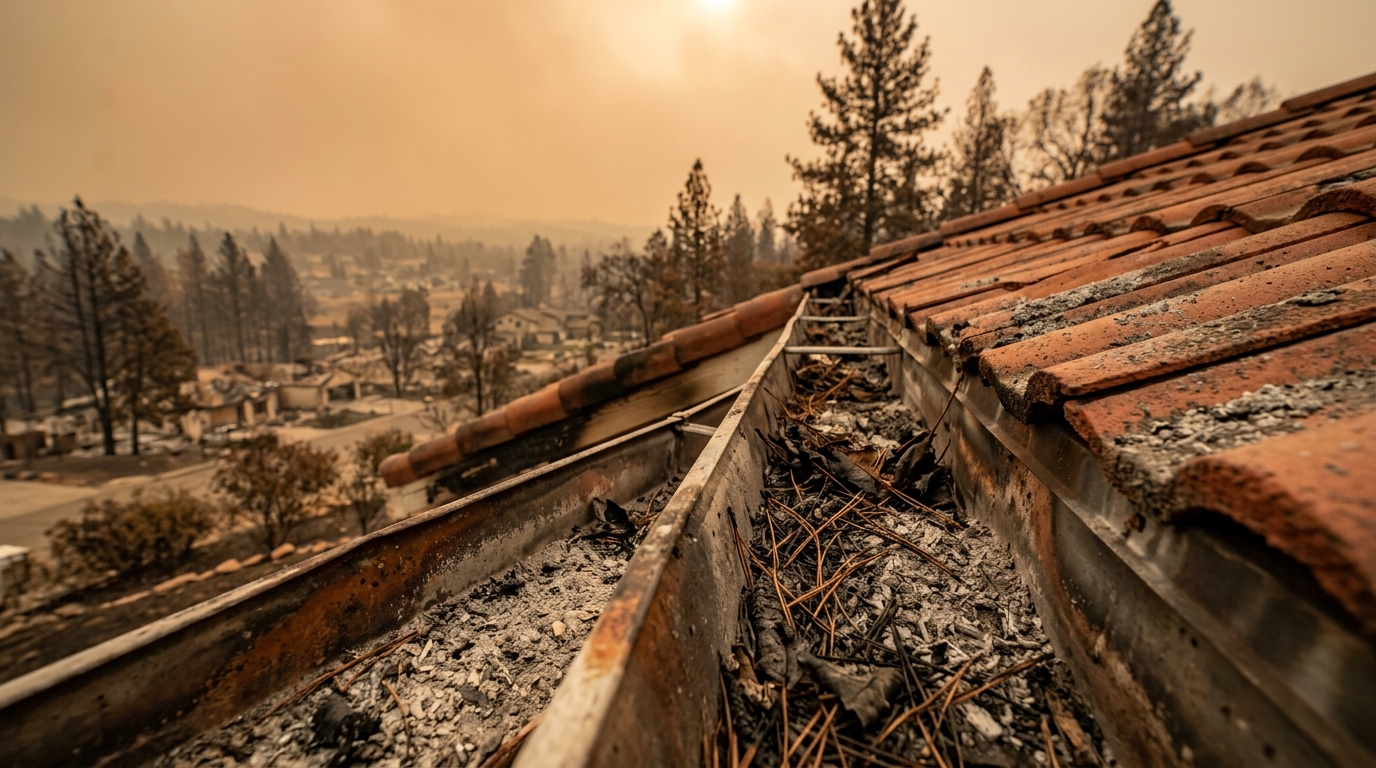
Heavy ash deposits in a Placer County gutter after Sierra Nevada wildfire fallout. Cleanup should happen before the first rain.
TL;DR
Post-wildfire ash gutter cleanup requires N95 or P100 respirator, eye protection, nitrile gloves, and long sleeves. Dry-vacuum or hand-scoop the ash first into double-bagged contractor bags, then rinse gutters with a low-pressure hose — never pressure-wash. Wait until air quality returns below AQI 100 and finish before the first rain. In Placer County, double-bagged wildfire ash is typically accepted free of charge at the Western Regional Landfill in Lincoln during declared disaster events. Document everything with timestamped photos for insurance claims under your debris removal coverage.
Why Wildfire Ash in Gutters Isn't Just Dirty Debris
Routine gutter debris is leaves, pine needles, and shingle grit. Wildfire ash is chemically and physically different. When a wildland-urban interface (WUI) fire burns through a community, the ash contains combustion products from vegetation plus everything else that burned — homes, vehicles, treated lumber, batteries, electronics, and plastics.
The Placer County Air Pollution Control District and Cal/EPA classify post-wildfire ash from urban-interface burns as hazardous because it commonly contains:
- Heavy metals — lead, arsenic, cadmium, and chromium from combusted construction materials and electronics
- Asbestos fibers — released from older home insulation, vinyl tile, and HVAC components built before 1980
- PAHs (polycyclic aromatic hydrocarbons) — combustion byproducts of plastics, foam, and petroleum products, classified as probable human carcinogens by the EPA
- Caustic alkali compounds — wood ash is highly alkaline (pH 9-13) and can cause skin and eye burns on contact
What's Actually in Post-WUI Wildfire Ash
Beyond the health hazard, ash is hygroscopic — it absorbs moisture from morning dew and humidity, then expands and binds with leaves and pine needles. By the time the first storm arrives, what was loose powder becomes a dense paste that blocks downspouts and forces overflow. See our guide to gutter overflow during heavy rain for what happens when this debris meets an atmospheric river.
PPE Checklist Before You Touch a Single Ash-Filled Gutter
Cal/OSHA and the California Department of Public Health both publish post-wildfire cleanup guidance that requires respiratory and skin protection any time you disturb ash deposits. A standard dust mask is not adequate. Surgical masks are not adequate. The minimum is an N95, and a P100 elastomeric respirator is far better.
Respirator (Required)
N95 minimum, P100 preferred. Verify the respirator is NIOSH-approved and properly fit-tested. Beards break the seal — shave the contact area or use a powered air-purifying respirator (PAPR). Replace cartridges per manufacturer guidance during heavy ash exposure.
Eye Protection
Sealed safety goggles, not open-sided safety glasses. Wood ash is caustic enough to cause chemical burns on contact with the eye, and fine particulates carry into the air the moment you scoop or vacuum.
Gloves & Skin Coverage
Heavy nitrile or rubber gloves — not cloth or cotton work gloves, which absorb contaminants. Long sleeves, long pants, and closed-toe boots. A disposable Tyvek coverall is ideal for heavy contamination scenarios.
Footwear & Decon
Boots with closed lacing systems. Plan to rinse boots and remove outer clothing in a designated decon area before re-entering the home. Wash work clothing separately from family laundry on hot.
Pro Tip
If anyone in the household has asthma, COPD, or cardiovascular disease, hire a professional. The risk of a respiratory event during ash cleanup is real, and medical literature from the post-Camp-Fire response in Butte County documented hospital admissions tied to DIY ash exposure. Hiring out a 2-3 hour cleaning job is cheaper than an ER visit.
The Two-Stage Cleanup Method: Dry First, Then Wet
The single most important rule of post-wildfire gutter cleanup: never start with water. Spraying dry ash with a hose creates a contaminated slurry that pours straight into your storm drain system, your foundation perimeter, and your landscape soil. Placer County AQMD guidance is explicit on this point — bulk ash must be removed dry before any rinse.
- 1
Verify air quality and timing
Check the AirNow.gov AQI for your zip code. Wait until particulate readings drop below 100 (moderate) for at least 48 hours and Cal Fire has confirmed your area is clear. Do all cleanup in early morning before afternoon up-canyon winds pick up resuspended dust.
- 2
Set up a containment zone at ground level
Spread a heavy painter's tarp under the work area. Place double-bagged contractor bags (3-4 mil minimum) at the base of the ladder. Stage a HEPA-filter shop vacuum, scoop, and trash bags within reach so you don't have to climb up and down repeatedly.
- 3
Dry-vacuum or scoop the bulk material
Using a HEPA shop vac with a long crevice tool, slowly draw ash and debris out of the gutter trough. For thick deposits, use a small plastic scoop to lift material into the bag — no dustpans, which fling fine particulates into the air. Work in 4-6 foot sections, rolling the bag closed between sections.
- 4
Mist lightly to suppress dust during dry phase
If material starts becoming airborne, use a fine garden-hose mister (not a spray nozzle) to lightly dampen the surface. The goal is to settle dust, not flush material. Stop misting if water begins to flow from the downspout.
- 5
Bag, seal, and label the dry waste
Double-bag the ash in heavy contractor bags. Squeeze out air slowly with the bag pointed away from your face. Tape the top shut and label with permanent marker: 'WILDFIRE ASH — HAZARDOUS.' Stage bags in a covered area away from children and pets.
- 6
Low-pressure rinse with directed runoff
Only after bulk removal: use a standard garden hose at low pressure (no pressure washer) to flush remaining residue toward the downspout. Direct the downspout outflow into a contained area — a tarp-lined wheelbarrow or rain barrel — so the runoff doesn't enter the storm drain or foundation soil.
- 7
Inspect and clear downspouts
Run water through each downspout. If you hear gurgling or see backed-up flow, the elbow at the bottom is likely clogged with ash sludge. Disassemble the elbow, scoop out the paste manually with PPE on, and reinstall.
- 8
Decon and dispose of contaminated supplies
Rinse boots and tools in a designated decon area. Bag and dispose of disposable PPE separately. Dispose of bagged ash per Placer County HHW guidelines (see disposal section below).
For homes with two-story rooflines, the safety calculus changes — the same ladder risks covered in our gutter cleaning ladder safety guide are amplified by reduced visibility from PPE, slick ash on roof edges, and heavier debris loads. Most Placer County homeowners hire out two-story gutter cleaning after a wildfire event for this reason.
Sierra fire dropped ash on your Placer County home?
We do post-wildfire gutter cleanup with HEPA vacuums, full PPE, and proper hazardous waste disposal. Includes documentation packet for your insurance claim.
Get a Post-Wildfire Cleanup EstimateSmoke Damage to Gutters: What to Inspect After the Fire
Even if your gutters didn't catch fire, prolonged smoke exposure leaves acidic residue that attacks gutter coatings and seam sealants. The damage is often subtle for the first 30-60 days and then becomes visible as streaking, dulling, or premature corrosion. Inspect your gutters within two weeks of any heavy smoke event.
How Wildfire Smoke Damages Different Gutter Materials
Painted aluminum gutters often develop "tiger stripes" — vertical dark streaks running down the front face — that look identical to normal weathering tiger stripes but appear within weeks instead of years. Our tiger stripe removal guide covers the chemistry. Wash smoke-exposed aluminum with a non-acidic gutter cleaner within 30 days to prevent permanent etching.
Galvanized steel gutters require closer attention — once smoke acids start breaking down the zinc galvanization, surface rust forms quickly and the only fix is full replacement or coating with a rust-converter primer plus topcoat. For homes with vinyl gutters in fire zones, this is also the moment to evaluate whether the system meets the new 2026 California WUI gutter code.
Where to Dispose of Bagged Wildfire Ash in Placer County
Curbside trash pickup is generally not the right channel for bagged wildfire ash. Most Placer County waste haulers — including Recology Auburn Placer and Recology Rocklin — explicitly prohibit putting hazardous wildfire debris in residential carts. Instead, the county activates a Household Hazardous Waste (HHW) program after major fire events.
Western Regional Sanitary Landfill
Lincoln, CA — serves Rocklin, Roseville, Lincoln, Loomis
During declared disaster events, accepts double-bagged wildfire ash from Placer County residents at no charge. Bring proof of residency. Confirm hours and current rules at placer.ca.gov/recycle.
Eastern Regional Landfill (Meadow Vista)
Meadow Vista, CA — serves Auburn, Foresthill, foothill communities
Accepts residential household hazardous waste including bagged ash from declared fire areas. Smaller facility — call ahead to confirm acceptance during high-volume periods.
Curbside trash cart (regular)
All cities
Generally NOT accepted. Recology and other haulers refuse pickup of identifiable wildfire ash. Putting ash in regular trash can result in driver refusal and a service charge.
Storm drain or yard
Anywhere
Illegal dumping. Wildfire ash is classified as hazardous when it includes urban-interface debris. Improper disposal can trigger Cal/EPA enforcement and fines starting at $1,000.
Pro Tip
After major fires, Cal Recycle and Cal OES often coordinate a no-cost residential ash disposal program through Placer County Environmental Health. Sign up for Placer Alert to receive notifications when these programs activate. The Mosquito Fire response in 2022 included free curbside ash bag pickup for Foresthill and Auburn residents within the burn perimeter — but you had to register.
Insurance Documentation: How to File a Cleanup Claim
Most California homeowners policies — whether through CSAA, Mercury, Allstate, the FAIR Plan, or others — include some form of debris removal coverage that extends to ash and soot cleanup when a covered fire event occurred. The key word is "covered" — the fire doesn't have to have damaged your home, but it does have to be a peril listed in your policy and tied to a recognized event (typically with a Cal Fire incident number).
Documentation Packet for Your Claim
- Timestamped photos before cleanup: Take photos of each gutter run, downspout, and visible ash deposits. Include a wide shot showing the home address marker.
- Cal Fire incident reference: Note the official incident name (e.g., "2022 Mosquito Fire CA-PNF-001234") and dates. Available at fire.ca.gov/incidents.
- AQI screenshots: Capture AirNow.gov readings for your zip code during the fire event showing elevated PM2.5 levels — establishes the smoke and ash exposure window.
- Cleanup invoices & receipts: Itemized receipt from a licensed gutter cleaning contractor, plus receipts for any DIY supplies (PPE, contractor bags, replacement gutter sections).
- Disposal receipts: Documentation from the Western Regional Landfill or HHW facility confirming hazardous ash drop-off.
- After photos: Document the cleaned gutter system to show the work was completed.
Submit the packet to your carrier within 60 days of the fire event — most policies have a notification window. For a deeper look at what California homeowners insurance does and doesn't cover for gutter-related losses, see our California homeowners insurance gutter damage guide.
Recent Placer County Fires That Dropped Ash on Rocklin Rooftops
Placer County sits downwind of much of the Sierra Nevada wildfire zone. Even fires burning in El Dorado, Nevada, Yuba, or Plumas counties commonly drop ash on Rocklin and Roseville rooftops because the prevailing afternoon winds funnel smoke up the American River canyon and across the I-80 corridor.
- 2021 Caldor Fire (221,835 acres): Burned across El Dorado County and dropped measurable ash on Rocklin, Roseville, and Folsom for over two weeks. AQI in Rocklin exceeded 200 (very unhealthy) on multiple days.
- 2022 Mosquito Fire (76,788 acres): Burned in the Foresthill and Volcanoville area of Placer and El Dorado counties. Direct ash fallout on Auburn, Meadow Vista, and the eastern edges of Rocklin and Loomis.
- 2020 North Complex Fire: Burned in Plumas County but dropped ash across Placer County for over a month. Sky turned orange in Sacramento on September 9, 2020 from this and combined Bay Area fires.
- 2018 Camp Fire (Butte County): Despite burning 90+ miles north, ash fallout reached Sacramento and Placer County on multiple days. Established the pattern of broader-area ash exposure from severe Sierra-foothill fires.
For the foothill communities directly inside the WUI — Auburn, Loomis, Penryn, Meadow Vista, Foresthill — ash exposure is functionally an annual event during fire season. Our Auburn and Loomis foothill gutter guide covers the additional considerations for properties in or adjacent to Cal Fire's State Responsibility Area.
Real-World Example: Stanford Ranch Cleanup After Mosquito Fire Fallout
A homeowner in Stanford Ranch called us in late September 2022, about ten days after the Mosquito Fire began dropping ash across western Placer County. The home had aluminum K-style gutters, no gutter guards, and pine trees along the back fence line. Ash plus burnt pine needles filled all 165 linear feet of gutter to roughly 60% capacity.
We used HEPA vacuums in P100 respirators, dry-bagged the bulk material into eight contractor bags, then did a low-pressure rinse with the runoff captured in a tarp-lined wheelbarrow at each downspout. Total job time was 4 hours. The bagged ash went to the Western Regional Landfill in Lincoln under the disaster waiver — no fee.
Project Summary
- Home: 2,200 sq ft, single-story, Stanford Ranch
- Linear feet: 165 LF aluminum gutters, 6 downspouts
- Ash volume removed: ~12 cubic feet (8 contractor bags)
- Cleanup time: 4 hours (2 technicians, full PPE)
- Disposal: Western Regional Landfill, Lincoln (no charge)
- Insurance result: Reimbursed under CSAA debris removal coverage, $640 total claim approved
The homeowner also added stainless-steel micro-mesh gutter guards the following spring to make future fire-season cleanup easier — guards don't prevent ash deposits, but they make removal a 30-minute brush-off job instead of a multi-hour HEPA-vacuum operation.
Frequently Asked Questions About Wildfire Ash Gutter Cleanup
Is wildfire ash in my gutters dangerous?
Yes. Post-WUI fire ash often contains heavy metals (lead, arsenic, cadmium), asbestos from older building materials, PAHs from combusted plastics, and caustic alkali compounds. The Placer County Air Pollution Control District classifies it as hazardous when structural debris is involved. Always wear N95 or P100 respirator, sealed goggles, nitrile gloves, and long sleeves before disturbing ash deposits.
Should I rinse ash out of gutters with a hose?
Not as the first step. Spraying dry ash with water creates a contaminated slurry that flows into storm drains, foundation soil, and landscape. Always dry-vacuum or hand-scoop the bulk material first, double-bag for hazardous-waste disposal, then use a low-pressure rinse only for residue. Never pressure-wash — it aerosolizes fine particulates and worsens contamination.
How long after a wildfire should I clean my gutters?
Wait until your local AQI returns below 100 (moderate) for at least 48 hours and Cal Fire has cleared your area. Then clean before the first rain — wet ash binds with leaves and pine needles into a cement-like sludge that overflows downspouts and is much harder to remove. After Caldor and Mosquito fire fallout, Placer County recommended a 72-hour wait window after primary ash deposition stopped.
Will my homeowners insurance cover wildfire ash gutter cleanup?
Often yes, under the debris removal provision of standard California homeowners policies. The fire must be a covered peril and tied to a recognized Cal Fire incident — your home doesn't have to have burned. Document with timestamped photos, save AQI screenshots, keep cleanup and disposal receipts, and submit a packet within 60 days. CSAA, Mercury, Allstate, and the FAIR Plan have processed these claims after recent Sierra fires.
Can wildfire smoke damage gutters themselves?
Yes. Acidic smoke residue accelerates oxidation on aluminum and can permanently etch the painted finish, leaving tiger striping. On galvanized steel, smoke acids attack the zinc coating and start surface rust within months. On vinyl, prolonged smoke exposure causes brittleness and discoloration. Inspect gutters within 14 days of any heavy smoke event for streaking, soft spots, or sealant failure.
Where do I dispose of bagged wildfire ash from gutters?
Not curbside — most Placer County waste haulers refuse pickup of identifiable wildfire ash. Take double-bagged material to the Western Regional Sanitary Landfill in Lincoln (serves Rocklin, Roseville, Loomis) or the Eastern Regional Landfill in Meadow Vista (serves Auburn and foothill communities). During declared disaster events, drop-off is typically free for Placer County residents. Confirm rules at placer.ca.gov/recycle.
Post-Wildfire Gutter Cleanup Across Placer County
Rocklin Gutter Guard provides HEPA-vacuum gutter cleanup, full PPE crews, hazardous waste disposal documentation, and insurance claim packets across Rocklin, Roseville, Auburn, Lincoln, and the rest of Placer County. We also install fire-rated gutter guards to make future fire-season cleanup faster.