
Class A Fire-Rated Gutter Systems for Rocklin Foothill Homes
Class A fire rated gutters in Rocklin are the difference between a roofline that sheds an ember storm and one that becomes a fuse for the rest of the house. Most Rocklin foothill homeowners learn the term "Class A" from their roofer or insurance carrier, then assume the gutters underneath inherit the rating automatically. They do not. Once a vinyl downspout, a foam insert, or a plastic-bristle screen lands on the eave, the entire Class A roof assembly degrades right where embers concentrate -- at the gutter line above the fascia.
This guide walks Rocklin and Placer County foothill homeowners through what Class A actually means at the gutter, which gutter and guard combinations qualify under the 2026 California WUI Code, what it costs to specify the system correctly, and how to vet a contractor who will install it without breaking the rating.
Already shopping for a fire-hardened gutter upgrade? Request a free Class A compliance estimate or read the underlying 2026 California WUI gutter code guide.
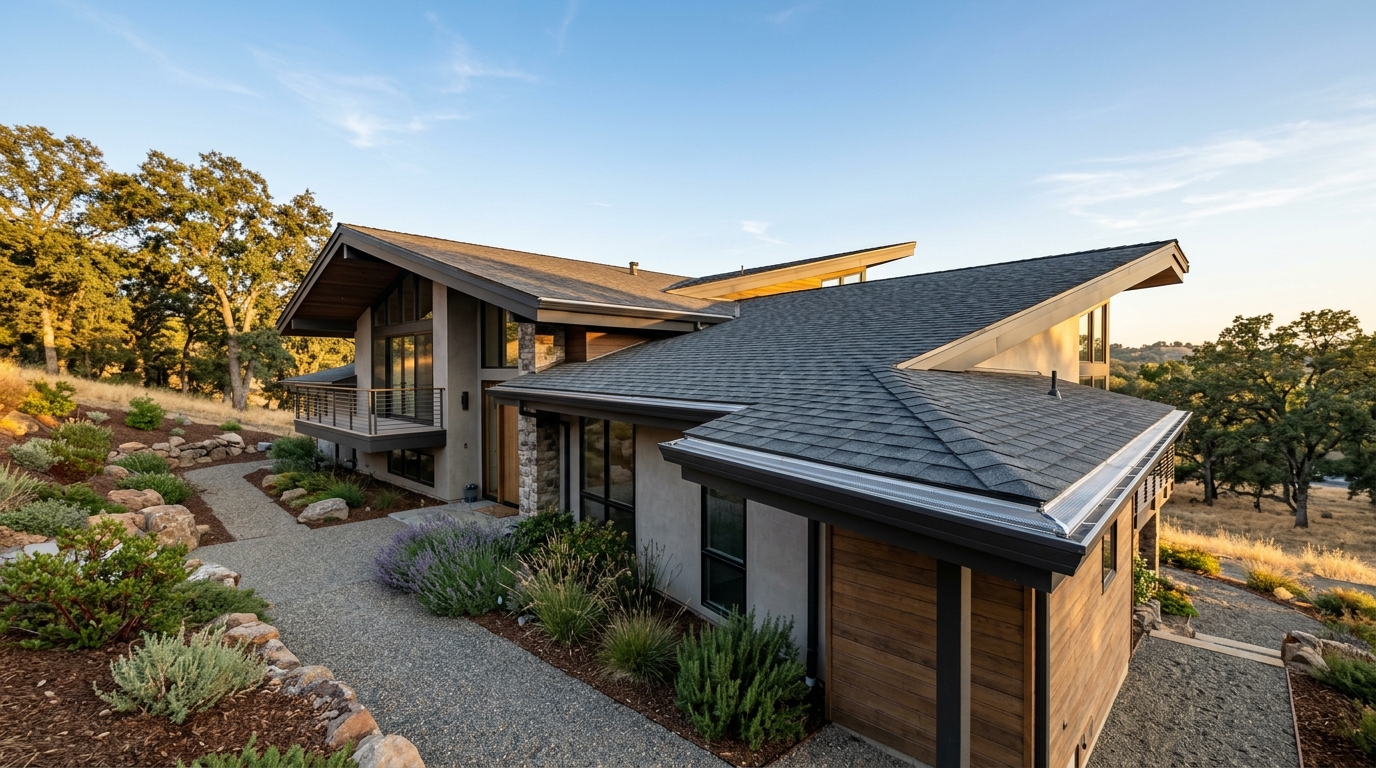
A Class A fire-rated assembly on a Rocklin foothill home: seamless aluminum gutter, hidden metal hangers, non-combustible drip edge, and stainless steel micro-mesh ember guard.
TL;DR
Class A is a roof-assembly rating under ASTM E108 / UL 790, not a gutter rating on its own. To keep a Rocklin foothill home Class A at the eave, the gutter, hangers, drip edge, fascia metal, and guard all have to be non-combustible. The compliant recipe is seamless aluminum or galvanized steel gutters with stainless steel micro-mesh guards on metal hangers. Vinyl gutters, foam inserts, and plastic-bristle guards break the rating. A typical 2,000 sq ft Rocklin foothill home runs $3,350-$5,600 for the full Class A compliant aluminum-plus-micro-mesh gutter system in 2026, with insurance discounts of 5-15% in High and Very High Fire Hazard Severity Zones.
Why Foothill Rocklin Needs Class A Gutters, Not Just a Class A Roof
Rocklin sits on the western edge of the Sierra foothill transition. East of Sierra College Boulevard, neighborhoods like Whitney Ranch, Whitney Oaks, and the Twelve Bridges side of Lincoln back directly onto annual grass, blue oak woodland, and chaparral. Climb a few miles east into Loomis, Penryn, Newcastle, and Auburn and the wildland-urban interface becomes the homeowner's back fence. CAL FIRE's 2025 Fire Hazard Severity Zone update placed large portions of eastern Rocklin and most of the Placer County foothill belt into Moderate, High, or Very High classifications.
That matters because foothill ember exposure is fundamentally different from suburban Sacramento Valley exposure. Embers ride evening foothill drainage winds, accumulate in roof valleys, and lodge in the first horizontal surface they hit. Almost always, that surface is the gutter. The 2022 Mosquito Fire in Placer and El Dorado counties destroyed structures more than a mile from the active flame front, with post-incident reports identifying gutter debris as a primary ignition path on multiple losses. The same pattern showed up in the Camp, Tubbs, and Caldor fires.
A Class A roof gives the field of the roof high resistance, but the eave is the failure point. If the gutter holds combustible debris, melts under heat, or has plastic components in the assembly, the rest of the Class A roof becomes irrelevant in the first 30 minutes of an ember storm.
How Embers Reach a Rocklin Foothill Eave
For a deeper look at how Mosquito Fire ash behaves in residential gutters, our post-wildfire ash cleanup guide for Placer County walks through the chemistry. The short version: foothill embers do not just light fires, they leave acidic, salt-laden residue that corrodes any non-metallic gutter component left behind.
What "Class A Fire Rated" Actually Means at the Gutter Line
Class A is the highest of three roofing fire-resistance classifications under ASTM E108 and the equivalent UL 790. The rating measures how a roof assembly responds to three distinct tests: an intermittent flame test, a spread-of-flame test, and a burning brand test. Class A passes the most severe burning brand -- a 2,000-gram piece of burning lumber dropped on the deck for the full duration of the test.
The critical word in the standard is assembly. Class A is granted to a tested combination of roof deck, underlayment, covering, edge metal, and adjacent components -- not to any single product in isolation. When that assembly extends to the eave, the gutter, hangers, drip edge, and gutter guard all become part of what an inspector evaluates. A Class A composition shingle paired with a vinyl gutter and a plastic insert does not produce a Class A assembly at the eave.
Class A Pass Criteria
No flame penetration, limited spread of flame (less than 6 feet), and no significant lateral flaming after the burning brand is extinguished. The roof must not produce flying brands of its own.
Why Eave Components Count
Section 705A of CBC Chapter 7A and now Chapter 5 of the 2026 CWUIC explicitly require non-combustible gutters and a means to prevent leaf and debris accumulation in WUI zones. Combustible eave components void the Class A assembly.
Listed Assemblies
Manufacturers list Class A assemblies in UL Online Certifications Directory (Roof Deck Constructions, TGFU.R-numbers). The listing names every component. Substitutions invalidate the rating.
Common Field Failure
A roofer installs a Class A shingle, then a separate gutter crew installs vinyl gutters with foam inserts. The home shows on the permit as Class A but fails the assembly definition at the eave -- a frequent finding on Placer County re-roof inspections post-2025.
Pro Tip
Ask your roofer for the UL listing number (TGFU.R-prefix) used for your Class A assembly. Then ask your gutter contractor to install components consistent with that listing -- aluminum or steel trough, metal hangers, non-combustible drip edge, and a metal mesh guard. Inspectors in Rocklin, Loomis, and Auburn increasingly cross-check the listing against installed materials.
Class A Compatible Gutter Materials Compared
Not every non-combustible material performs the same way under foothill ember loads. The four candidates Rocklin Gutter Guard installs on Class A assemblies are seamless aluminum, galvanized steel, Galvalume steel, and copper. Vinyl is included in the chart only to make the gap visible.
Class A Eligibility by Gutter Material
Aluminum: The Workhorse Choice for Rocklin
Seamless 5K and 6K aluminum gutters in 0.027 to 0.032 thickness are the default specification for most Rocklin foothill homes. Aluminum is non-combustible, will not rust in Sacramento Valley humidity swings, and accepts factory color baked-on enamel that resists UV at 100-degree summer temperatures. The melt point of roughly 1,220 degrees Fahrenheit is well above any sustained ember temperature you would see on a residential roof in a wind-driven event. Aluminum's only weakness against extreme radiant heat is deformation, but the assembly remains non-combustible and Class A compliant.
Galvanized and Galvalume Steel: The Foothill Upgrade
For homes east of Loomis, in upper Penryn, and along the Newcastle ridge where direct flame exposure is a real possibility, galvanized or Galvalume steel is the upgrade. Steel will not deform until well over 2,000 degrees Fahrenheit and holds its shape under radiant heat that would warp aluminum. Galvalume (zinc-aluminum-coated) outlasts plain galvanized by 20 to 40 percent in the foothill UV climate. The trade-off is weight, fastener requirements, and a 15 to 25 percent price premium.
Copper: The Custom-Home Standard
On custom Granite Bay, Loomis Basin, and Auburn estate homes, half-round copper paired with copper downspouts is the architectural standard. Copper is non-combustible, naturally fungicidal (which suppresses moss and algae growth that would otherwise carry embers), and develops a self-healing patina. Cost is two to three times aluminum, but on homes already specifying clay tile or natural slate, copper is the only gutter material that visually and structurally matches.
Inside the broader aluminum vs vinyl vs steel gutter comparison for Rocklin, you will see the same pattern: anything non-combustible can carry a Class A rating, but installation details and guard selection determine whether you actually get the rating in the field.
Components That Quietly Break a Class A Gutter Assembly
The most common Class A failures in Placer County are not the gutter itself -- they are the small parts. Every one of the components below has shown up on Rocklin Gutter Guard inspections of homes the owner believed were "already fire safe".
Plastic gutter clips and hidden hangers with nylon spacers
Many big-box retrofit kits use polyethylene or nylon spacer sleeves on hidden hangers. These melt at 250-400 degrees Fahrenheit and break the non-combustible assembly. Specify all-metal hidden hangers with no plastic isolation.
Foam gutter inserts (poly-urethane or polyether)
Marketed as ember guards in some big-box stores. They are not. Foam ignites and sustains combustion. They also degrade in 2-4 years under Sacramento Valley summer heat, leaving fragments that hold embers.
Plastic-bristle brush guards
Polypropylene bristles are combustible. Stainless steel bristle versions exist and are fine, but the plastic versions are common in homeowner-installed retrofits and break the rating immediately.
Vinyl drip edge or PVC fascia covers
Vinyl-coated wood fascia trim and PVC drip-edge profiles are still sold in Northern California. The drip edge sits directly above the gutter and is part of the eave assembly, so a vinyl drip edge fails Class A even with aluminum gutters.
Combustible downspout extensions and splash blocks
Black corrugated plastic flex-pipe extensions and PVC underground transitions sit at ground level but become ember collectors during a fire. Use rigid aluminum or galvanized steel extensions and concrete splash blocks instead.
Sealed metal gutters with metal mesh guard
Aluminum or steel trough plus stainless steel micro-mesh on metal hangers is the gold-standard Class A compliant assembly. Verify with the installer that every fastener, hanger, and clip is metal.
For the full code-level treatment of why these substitutions fail, our wildfire gutter hardening guide walks through each material at the molecular level and explains the timing of ignition under foothill ember loads.
Want a Class A compliant gutter system on your Rocklin foothill home?
We inspect the existing eave assembly, identify which components break the Class A rating, and provide a fixed-price scope to bring the entire roofline into 2026 CWUIC compliance.
Get a Free Class A Compliance EstimateEmber Guard Selection for a Class A Assembly
The 2026 California WUI Code requires "a means to prevent the accumulation of leaves and debris" in the gutter. For a Class A assembly, that means is itself non-combustible. Inside that constraint, three guard tiers work for foothill Rocklin homes -- each with a different defensive ceiling against ember showers.
Tier 1: Stainless Steel Micro-Mesh (Best)
316-grade stainless steel mesh on an aluminum or steel frame. Mesh openings of 50-100 microns block embers, oak leaves, pine needles, and even shingle grit. Suitable for high ember exposure neighborhoods like Whitney Ranch, Loomis foothill, and Auburn ridge homes. Twenty-plus year lifespan with zero plastic in the assembly.
Tier 2: Aluminum Perforated Cover
Solid aluminum cover with stamped perforations. Non-combustible and Class A compatible. Perforation size lets fine debris through but blocks embers and leaves. Best for tract homes in Stanford Ranch and central Rocklin where pine needle and oak load is moderate.
Tier 3: Aluminum or Stainless Wire Screen
Basic woven metal screen. Meets the letter of the 2026 CWUIC and is Class A compatible, but allows more debris through than tier 1 or 2. Acceptable on Sacramento Valley properties in lower fire hazard zones; not recommended for foothill homes within 500 feet of wildland edge.
Stainless Bristle Brush
Non-combustible if the bristles are stainless steel. Verify in writing -- many big-box bristle inserts are polypropylene. Stainless versions work for short runs and tight valleys but underperform mesh on overall debris exclusion.
Foam or Polyurethane Insert
Combustible. Breaks Class A. Degrades in foothill heat. Avoid entirely.
Vinyl or Plastic Screen
Combustible polymer. Breaks Class A. Common in DIY kits but explicitly prohibited under the 2026 CWUIC for any property in a designated FHSZ.
For a Whitney Ranch or Whitney Oaks home backing onto open space, Tier 1 stainless micro-mesh is the only guard we recommend. Most homes land between $12 and $20 per foot installed; we confirm the exact price after measuring. The marginal cost over a perforated cover is recovered in three to five years of avoided cleanings, and the ember-blocking performance is materially better in a wind-driven event.
Class A Fire-Rated Gutter System Costs in Rocklin (2026)
Total cost depends on home size, eave linear footage, gutter material, guard tier, and whether the existing fascia is sound or needs repair. The following ranges are based on 2026 Rocklin Gutter Guard install pricing for a typical 2,000 sq ft single-story or two-story foothill home with 150-200 linear feet of eave.
Class A Compliant Gutter Assembly Cost Ranges
What Drives the Range
- Eave linear footage: A 1,400 sq ft cottage runs about 110 linear feet, while a 3,500 sq ft custom Loomis home with multiple roof planes runs 280-340 linear feet.
- Two-story access: Adds 10-20% on labor due to scaffold or lift requirements for gable ends.
- Fascia repair: Foothill homes with prior gutter overflow often have rotted fascia at the rear elevation. Repair runs $18-$32 per linear foot before new gutters can be hung.
- Downspout count and routing: Each downspout adds $90-$220 installed. Foothill homes with steep grade often need extra downspouts to handle storm flow.
- Permit and inspection: Re-roof permits in Rocklin run $180-$420 plus 1-2% of project value. Standalone gutter replacement does not require a permit unless tied to fascia structural work.
Insurance Offset
Most major California carriers now offer 5-15% premium discounts for documented Class A roof assemblies including ember-resistant gutters. CSAA, Mercury, and Farmers all maintain home-hardening checklists, and CAL FIRE's Safer from Wildfires program adds further reductions for homes with full Zone 0 defensible space compliance. On a typical $4,200 annual policy in High FHSZ areas of Rocklin, that translates to $210-$630 per year in savings -- enough to recover the upgrade in three to seven years on the aluminum-plus-mesh recipe.
For the broader local code context, including how AB 3074 Zone 0 ties into the gutter assembly, see our AB 3074 Zone 0 defensible space gutter guide for Placer County.
Class A Gutter Specification Checklist for Rocklin Homeowners
Use this list when reviewing contractor proposals. Any "fire-rated gutter" quote that does not address every line below is incomplete.
- 1
Confirm your FHSZ designation in writing
Pull your address from the City of Rocklin FHSZ map or CAL FIRE FHSZ Viewer. Save the screenshot. The designation determines whether the 2026 CWUIC applies and whether insurance discounts are available.
- 2
Specify gutter material and thickness
0.027 or 0.032 aluminum is the standard. Galvanized or Galvalume steel for direct flame exposure neighborhoods. Copper for custom applications. The proposal should name the alloy and gauge.
- 3
Specify hidden hangers as all-metal
Zinc-plated steel hidden hangers with no plastic isolation or nylon spacer sleeves. Spacing of 24 inches on center for foothill snow load and ember debris weight.
- 4
Specify drip edge and apron
Aluminum or galvanized steel drip edge under the first course of shingles, lapped over the gutter back. No vinyl. No PVC.
- 5
Specify guard product and listing number
Stainless steel micro-mesh on aluminum or steel frame for foothill homes. Get the manufacturer model and any UL or ICC-ES listing number in writing.
- 6
Specify downspout material and outlet count
Aluminum or galvanized steel rectangular downspouts in 2x3 or 3x4. No more than 50 feet of gutter per outlet (Berger Building Products' SMACNA-based sizing guide). Rigid metal extensions, not corrugated plastic flex pipe.
- 7
Coordinate with the roofer on UL listing
If you are re-roofing, ask the roofer for the Class A UL TGFU.R-listing being used. Forward to the gutter contractor so the eave components match the listing.
- 8
Document the install for insurance
Photograph each step: stripped fascia, drip edge, gutter, hangers, guard. Save the contractor invoice with the material specifications. Submit the package to your insurance carrier for the home-hardening discount review.
Rocklin and Placer Foothill Neighborhood Snapshot
Class A gutter priorities shift by neighborhood depending on FHSZ designation, vegetation type, and prevailing wind direction. Here is how Rocklin Gutter Guard scopes a foothill assembly across the most common service areas.
- Whitney Ranch & Whitney Oaks:High FHSZ at the eastern edge. Backed by annual grass and oak woodland. Spec: aluminum or galvanized steel + stainless micro-mesh, all-metal hangers. Insurance discount eligibility is highest here.
- Stanford Ranch / Sunset West:Moderate FHSZ in most blocks, High in pockets near open space. Aluminum + perforated cover meets code, but micro-mesh is recommended for homes within 200 feet of greenbelt.
- Loomis Basin & Penryn:Very High FHSZ across most of the area. Direct flame exposure possible. Spec: galvanized or Galvalume steel + stainless micro-mesh. All-metal hidden hangers at 24 inches on center.
- Newcastle / Auburn Ridge:Very High FHSZ. Steep terrain channels embers into roof valleys. Spec: Galvalume steel + stainless micro-mesh, extra downspouts for storm-flow capacity, rigid metal extensions to splash blocks.
- Granite Bay Estates:Moderate to High FHSZ. Custom homes with clay tile or natural slate roofs. Copper half-round + stainless micro-mesh is the architectural and code-compliant standard.
- Twelve Bridges (Lincoln):Mostly Moderate FHSZ but exposed to evening foothill drainage winds. Aluminum + micro-mesh meets code with strong margin. Watch for builder-grade vinyl downspouts on tract homes from 2001-2010.
Frequently Asked Questions About Class A Fire-Rated Gutters
What does Class A fire rated mean for a gutter system?
Class A is the highest fire-resistance rating under ASTM E108 and UL 790, applied to the entire roof assembly -- not the gutter alone. To keep the rating at the eave, the gutter, hangers, drip edge, fascia metal, and guard must all be non-combustible. In Rocklin foothill WUI zones, that means aluminum, galvanized steel, or copper gutters paired with metal hangers and a metal mesh guard.
Are aluminum gutters Class A fire rated for Rocklin foothill homes?
Yes, when installed correctly. Aluminum is non-combustible (melts at roughly 1,220 degrees Fahrenheit) and meets the 2026 CWUIC non-combustible material requirement. To preserve a Class A assembly, the aluminum gutter must be paired with metal hangers, a non-combustible drip edge, and a stainless or aluminum mesh guard. Plastic clips, vinyl screen guards, or foam inserts break the rating.
Do I need a Class A fire rated gutter system in Rocklin?
If your Rocklin or Placer County property is in a Moderate, High, or Very High FHSZ -- which includes most foothill-edge neighborhoods east of Sierra College Boulevard and across Loomis, Penryn, Newcastle, and Auburn -- the 2026 CWUIC requires non-combustible gutters and ember-resistant guards whenever you re-roof, replace gutters, or build an addition. Inspectors evaluate the gutter as part of the Class A roof assembly.
How much does a Class A fire rated gutter system cost in Rocklin?
A typical 2,000 sq ft Rocklin foothill home with 150-200 linear feet of eave runs $3,350-$5,600 for a fully Class A compliant aluminum-plus-micro-mesh assembly in 2026, with the micro-mesh guard at $12-$20 per linear foot installed. Galvalume steel runs $4,950-$8,000. Copper assemblies on custom homes run $9,050-$14,400+. Insurance discounts of 5-15% in High and Very High FHSZ areas typically recover the upgrade in 3-7 years.
Can I keep my existing gutters and just add a fire rated guard?
If your existing gutters are aluminum, steel, or copper and structurally sound with metal hangers, you can add a stainless micro-mesh or aluminum perforated guard and end up with a Class A compliant assembly. If your gutters are vinyl or PVC, the guard alone does not bring the assembly to Class A -- vinyl is combustible and would cause the Class A roof to fail at the eave during a re-roof or addition permit.
What gutter guard works best with a Class A fire rated system?
Stainless steel micro-mesh on an aluminum or steel frame is the gold standard. It blocks embers, pine needles, oak leaves, and shingle grit while remaining fully non-combustible. Aluminum perforated covers also qualify and cost less. Avoid foam, plastic-bristle brushes, vinyl screens, and any guard with combustible components -- a single combustible element at the eave can compromise the Class A rating.
Specify a Class A Compliant Gutter System for Your Rocklin Foothill Home
Rocklin Gutter Guard installs Class A fire-rated gutter assemblies across Rocklin, Loomis, Penryn, Newcastle, Auburn, Lincoln, and the surrounding Placer County foothill belt. We verify your FHSZ designation, scope an assembly that survives a foothill ember storm, and document everything for your insurance carrier. Free on-site estimates.