
Rocklin Quarry Park & Granite Bedrock Drainage: Why Homes Near the Quarry District Need Custom Downspout Routing
Rocklin Quarry Park drainage is its own engineering problem. Homes on the blocks ringing Quarry Park, Big Gun Quarry, and the historic Quarry District sit on shallow granite bedrock -- the same Penryn Pluton that the city was literally cut out of in the 1860s. That geology turns a routine downspout install into a custom routing job, because the soil layer above the rock is too thin to absorb anything the gutters discharge.
If you live near Rocklin's Quarry District and see water pooling at your foundation after every storm, the downspouts are not necessarily broken. The water has nowhere to go after it leaves them. This guide explains why the Quarry District geology is unique within Placer County, what custom downspout routing actually looks like on rocky soil, and how to scope the right drainage system for your specific lot.
Live near Quarry Park and dealing with foundation water issues? Schedule a free Quarry District drainage assessment or read our deeper decomposed granite drainage guide for Rocklin.
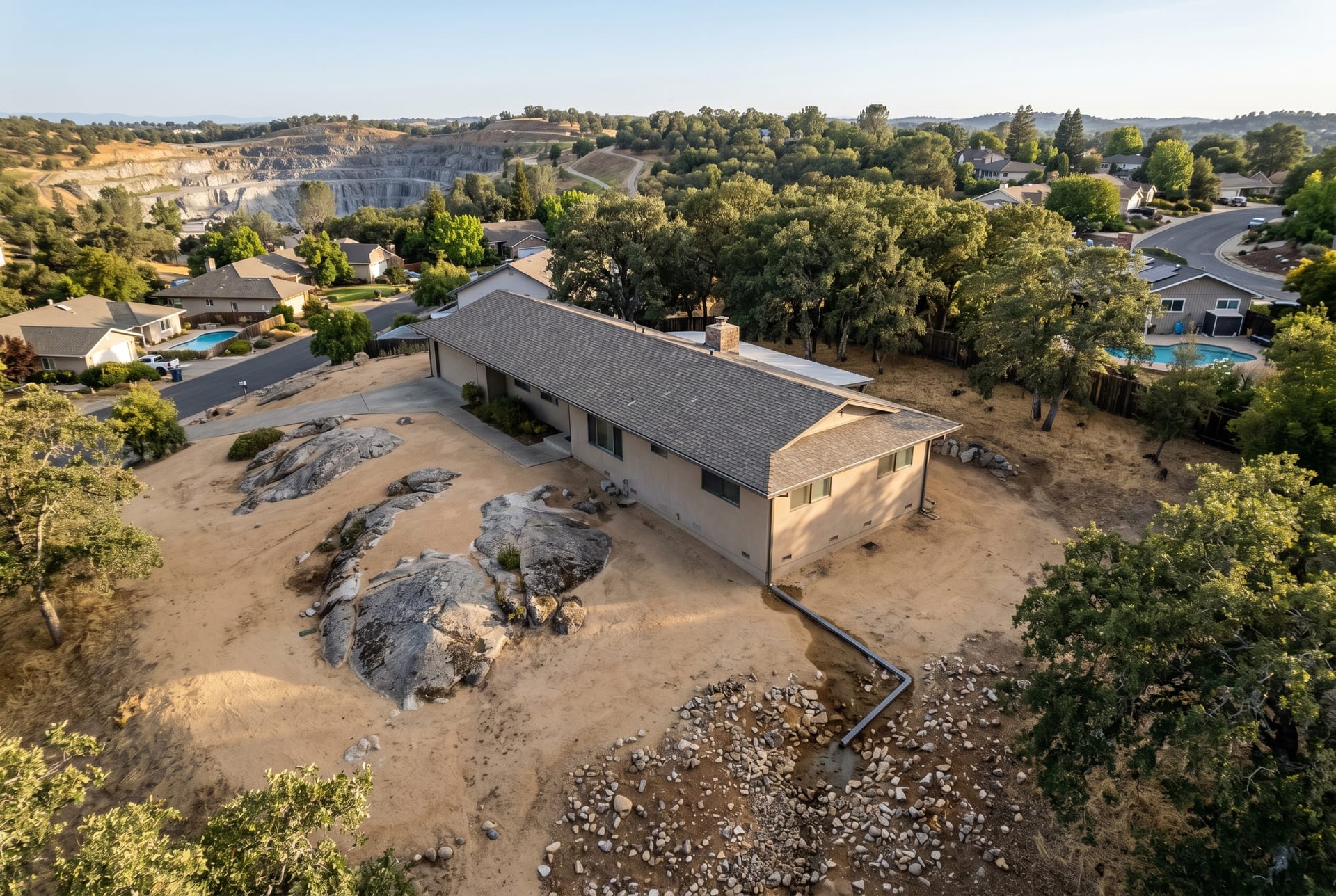
A typical Quarry District lot in Rocklin. Granite outcrops at grade, shallow soil cover, and a quarry rim visible behind the property -- all signs that downspout routing has to be designed around the bedrock.
TL;DR
Homes around Rocklin's Quarry Park sit on the shallowest granite bedrock in the city -- often 6-18 inches below grade. Standard downspouts dumping onto splash blocks fail here because water cannot percolate through the rock and migrates back toward foundations. Custom routing means: oversized downspouts (3x4), sealed solid-pipe lines pitched above the bedrock, and a daylit discharge at the property edge. Skip the percolation test and you are guessing. Plan around the rock and the system works for decades.
Why the Quarry District Is the Hardest Drainage Zone in Rocklin
The Quarry District covers the blocks east of Pacific Street, around Quarry Park Adventure, the Big Gun Quarry pit, and the original Rocklin town core. From the 1860s through the early 1900s, this area was an active granite quarry that supplied paving stones, building blocks, and curbs to San Francisco, Sacramento, and the transcontinental railroad. The historic quarrying did three things to the local geology that still shape drainage today.
- Topsoil was stripped. Decades of quarry operations removed the original soil profile from large sections of what is now residential. Lots that were later platted often have a thin layer of fill or imported soil sitting directly on cut granite.
- The bedrock was cut, not weathered. Most of Rocklin sits on weathered decomposed granite (DG) that breaks down to gritty soil over time. Quarry District lots more often have hard, fresh-cut granite at shallow depth -- much harder to trench through than weathered rock.
- Drainage paths were re-engineered. Old quarry pits collected water; the city later filled and graded around them. Some Quarry District lots sit on engineered fill that drains differently from the surrounding native rock.
Compare this to a newer Whitney Ranch or Stanford Ranch lot, where bedrock typically sits at 18-36 inches and there is enough native soil above it to absorb modest amounts of water. In the Quarry District, you might have 8 inches of soil over a hard granite cap. There is essentially no buffer for a misrouted downspout.
Local Field Note
On a recent project two blocks from Quarry Park Adventure, we hit solid granite at 9 inches. The homeowner had four downspouts dumping straight onto splash blocks and a recurring wet spot at the back foundation corner. The fix was not a deeper trench -- it was rerouting all four lines into shallow 3-inch PVC pitched along the granite surface to a daylit discharge at the back fence. Total trench depth never exceeded 12 inches. The wet spot disappeared within one storm cycle.
The Standard Quarry District Drainage Failure Pattern
We see the same failure sequence on roughly 7 out of 10 Quarry District homes when we are called out for foundation moisture. It plays out like this:
- Builder or previous owner installs standard 2x3 aluminum downspouts with splash blocks at each elbow.
- First atmospheric river of the season dumps an inch of rain in a few hours. The downspouts handle the volume, but the splash blocks cannot disperse that much water on shallow soil.
- Water enters the top inches of soil, reaches granite within seconds, and starts moving laterally along the rock interface.
- On most Quarry District lots, the bedrock surface tilts back toward the house because the original cut grade aimed at the quarry pit. Water follows the slope of the rock, not the visible slope of the lawn.
- Within 30-60 feet of travel along the rock, the water surfaces -- usually at a foundation footing, a planting bed, or a low spot in the side yard.
- Homeowner sees standing water near the house and assumes the gutter is leaking or the foundation is cracked. Both are usually fine. The downspout discharge point is the actual failure.
That subsurface lateral flow along the bedrock is invisible. You cannot see it from the surface, you cannot fix it by re-grading the lawn, and you cannot pretend it away by adding mulch. The only durable fix is to intercept the water at the downspout and pipe it past the bedrock interface to a discharge point the geology can handle.
- Sealed PVC underground extensions to a daylit discharge
- Pop-up emitters at the property line with positive line slope
- Curb cuts to street drainage where Public Works allows
- Catch basins on hardscape connected to closed pipe
- Splash blocks alone on shallow rock
- Standard French drains with no discharge plan
- Gravel pits or dry wells without a percolation test
- Corrugated black pipe on long underground runs
What Custom Downspout Routing Looks Like on Rocky Soil
Custom routing on a Quarry District lot is the opposite of a builder-grade install. Instead of treating each downspout as an independent splash point, the system is designed as a network that moves all roof water across the granite surface to a single controlled discharge. The four design moves we apply on every Quarry District job:
1. Oversize the gutters and downspouts upstream
We default to 6-inch K-style gutters and 3x4 downspouts on Quarry District homes over 1,800 square feet of roof. The bigger profile gives the system margin during the December and January atmospheric river events Placer County now sees almost annually. See our 5-inch vs 6-inch gutter sizing guide for Rocklin for the math.
2. Use sealed solid-pipe lines, not perforated
On rocky soil, the goal is transport, not drainage. We use 4-inch SDR-35 PVC or schedule 40 for every underground run. No gravel envelope, no filter fabric, no perforations -- just a sealed conduit that carries water past the bedrock to a daylit point. The full installation pattern is detailed in our underground gutter drainage and French drain guide.
3. Trench above the bedrock, not through it
We target trench depth of 8-14 inches, kept entirely within the soil layer above the granite. That means using a smaller pipe, a shallow cover, and a continuous 1-2 percent slope. Hydraulic breakers cost $500-$2,000 in added project time. Avoiding them with a smarter route saves real money and shortens installation by days.
4. End at a defensible discharge point
A line is only as good as where it terminates. On Quarry District lots, we discharge to a daylit pop-up emitter at the lowest property corner, a curb cut at the street where Public Works permits one, or a buried turnout into a swale. "Pipe ends here" is never a discharge plan on granite.
Pro Tip: Before any trenching starts, walk the proposed line and pour a 5-gallon bucket of water at the planned discharge point. If the water runs away cleanly, the discharge works. If it puddles or backs up, the design needs to change before you spend a dollar on PVC.
Bedrock Depth Across the Quarry District & Surrounding Rocklin Neighborhoods
Bedrock depth is highly variable, even within a single block. The numbers below are field estimates from Rocklin Gutter Guard installations across the Quarry District and adjacent neighborhoods. They are useful for planning, but every project still needs a test hole before pricing.
| Area | Typical Bedrock Depth | Routing Difficulty |
|---|---|---|
| Old Town / Pacific Street core | 6-12 inches | Very high |
| Quarry District blocks (off Rocklin Rd) | 8-18 inches | Very high |
| Around Quarry Park Adventure | 6-15 inches | Very high |
| Sunset West (older sections) | 15-30 inches | High |
| Springfield | 12-24 inches | High |
| Stanford Ranch | 18-30 inches | Moderate to high |
| Whitney Ranch | 18-36 inches | Moderate |
Field estimates from Rocklin Gutter Guard installations. Single-lot variation can exceed 12 inches. Always verify with a test hole.
The closer you live to Quarry Park, the shorter the trench depth you have to work with. That is not a limitation -- it is a design constraint that shapes every other decision. Shorter pipe runs, more downspouts, larger gutters, and a strict commitment to daylit discharge are all ways to compensate for the rock you cannot trench through.
Live near Quarry Park and not sure how shallow your bedrock is?
We dig a free pilot test hole on every Quarry District drainage estimate. You will know exactly what you are working with before any pricing or design.
Schedule a Free Quarry District AssessmentRouting Strategies by Quarry District Lot Type
No two Quarry District lots route the same way. Topography, lot orientation, neighbor grading, and proximity to existing storm infrastructure all matter. Here are the five lot patterns we see most often and the routing approach that works for each.
Downslope-toward-street lot. Easiest case. Route all downspouts to a single 4-inch PVC trunk line that daylights at a curb cut or splash plate near the sidewalk. Trench depth typically 10-12 inches.
Downslope-toward-rear-yard lot. Common around Quarry Park itself. Route to a pop-up emitter at the back fence line or, if conditions allow, a swale that carries water along the property edge to a low corner.
Flat lot with no obvious downslope. Hardest case. Requires longer pipe runs, sometimes a low-profile sump and pump system, and very careful slope verification along the entire trench. Plan on premium pricing.
Lot with exposed granite outcrop in yard. Route the trench around the outcrop, never through it. Outcrops are also useful as natural discharge surfaces -- a pop-up emitter aimed at a granite slab sheets water cleanly into a swale below.
Corner lot with two street frontages. Often the best option in the Quarry District. Split the roof load across two trunk lines, one to each curb, and you cut the volume each line has to carry in half.
For homes on corner lots that also slope, our hillside and sloped lot drainage guide for Placer County covers how to combine the routing approaches above with grade-driven discharge planning.
What If My Rocklin Home Is Not in the Quarry District?
The same custom routing principles apply across most of Rocklin and the surrounding foothill cities -- the depth budget just gets bigger as you move away from the historic quarry. Whitney Ranch, Stanford Ranch, and Springfield homes typically have 18-36 inches of soil above the bedrock, which gives you more room for traditional French drain designs and slightly deeper pipe runs.
On the other end of the spectrum, parts of Rocklin border on clay soil pockets where the issue inverts -- water cannot move down because the clay is impermeable, not because the rock is. Our clay soil foundation drainage guide for Rocklin covers that case in detail. The fixes are different, but the diagnostic process -- test hole first, design to the geology -- is identical.
- - Quarry District / Old Town: shallow granite, custom routing required
- - Stanford Ranch / Whitney Ranch: moderate granite depth, hybrid systems work
- - West Roseville border: deeper soils, traditional French drains feasible
- - Penryn / Newcastle: highly variable, always test before designing
- - Loomis Basin: granite plus clay seams, expect surprises
Five Questions to Ask Before Hiring Anyone for Quarry District Drainage Work
Most drainage failures we replace in the Quarry District were installed by general landscape contractors using a Sacramento-valley playbook. The questions below screen out crews who are not actually familiar with the local geology.
- "Will you dig a test hole before pricing?" The right answer is yes. Quarry District bedrock varies enough that any quote without a pilot dig is a guess.
- "Are you using perforated pipe or solid PVC, and why?" On rocky Quarry District soil, the answer should be solid pipe in almost every case.
- "Where exactly will the line discharge, and have you verified it works?" Vague answers are red flags. The contractor should walk you to the discharge point and explain the slope and capacity.
- "What is your plan if we hit rock at 10 inches?" A good contractor has three answers: re-route shallower, switch to a different lot edge, or bring in a breaker with a clear cost adder.
- "Will you do a hose test before backfill?" This is the single best indicator of a thorough crew. Pour water through the line before covering it, and any pitch or fitting issue shows up immediately.
For more on hiring the right crew for any Rocklin gutter or drainage project, see our how to choose a gutter company in Rocklin checklist.
Frequently Asked Questions About Quarry District Drainage
Why does water pool around my Rocklin foundation if my downspouts look fine?
On most Quarry District lots, the issue is not the downspout itself -- it is what happens after the water leaves it. Granite bedrock under your yard is often within 12-30 inches of the surface. When your downspout discharges onto a splash block, the water enters the thin soil layer, hits the rock, and migrates sideways back toward the foundation. The fix is custom routing: a sealed underground line that carries water past the bedrock interface to a daylit discharge point downslope or at the property line.
How do you drain downspouts on rocky soil near Quarry Park?
Three rules apply on rocky Rocklin soil. First, use solid smooth-wall PVC, not perforated pipe -- you are transporting water, not draining it into the rock. Second, keep trench depth shallow (8-14 inches) and pitch the line at 1-2 percent slope to a daylit discharge. Third, increase downspout count and size (3x4 instead of 2x3) so each line carries less concentrated flow. Together these moves let you route storm water across granite without needing to break through it.
Can you install French drains in granite bedrock under Rocklin homes?
Yes, but only if the design is modified. A traditional French drain assumes the soil at the bottom of the trench can absorb water. On granite bedrock that assumption fails -- the perforated pipe just sits in a gravel-filled trough that fills up and overflows. The working version on Rocklin Quarry District lots uses perforated pipe in the wet zone, transitions to solid pipe past the bedrock interface, and discharges at a daylit point. We always run a test hole first to verify bedrock depth before pricing a French drain on a Quarry-area lot.
Why are Quarry District homes harder to drain than other parts of Rocklin?
The Quarry District sits directly above the same granite body that the historic Big Gun and Secret Ravine quarries cut into. Bedrock depth in this part of Rocklin is the shallowest in the city -- often 6-18 inches in old town blocks off Pacific Street and Rocklin Road. The original soil profile was effectively scraped down by quarry operations and decades of fill, leaving very little permeable layer above the rock. That makes downspout routing more critical here than in newer subdivisions where bedrock can sit at 24-36 inches.
What is custom downspout routing and how is it different from a standard install?
Standard downspout install: water exits the elbow, hits a splash block, and disperses onto the lawn. That works on deep alluvial soil. Custom routing on a Quarry District lot: each downspout is sized to the roof load, connected to a sealed PVC line tunneled above the bedrock, pitched continuously to a controlled discharge, and protected from root intrusion. The work involves a percolation or test-hole assessment, hand or mini-excavator trenching above the rock, fitting around granite outcrops, and verifying flow with a hose test before backfill.
How do I know if my Rocklin home is on shallow granite bedrock?
Three quick checks. First, walk your property and look for exposed granite outcrops in lawns, planting beds, or along fence lines -- if rock is visible at grade anywhere on the lot, the rest of the property has shallow bedrock too. Second, look at neighbors who have done landscape work; trenches usually expose the bedrock layer. Third, request an on-site test hole before any drainage project. We dig a small pilot in the proposed trench area to verify depth before we price the work, so the design matches the actual geology rather than a guess.
Drainage Built for Rocklin's Quarry District, Not a Sacramento Subdivision
Rocklin Gutter Guard installs gutter systems and custom downspout routing designed specifically for the granite bedrock under the Quarry District, Old Town Rocklin, and the older blocks around Pacific Street and Rocklin Road. We dig a free test hole, size the system to your actual roof load and bedrock depth, and warranty the discharge path. Free on-site assessments across Rocklin, Loomis, Penryn, Newcastle, and west Roseville.