
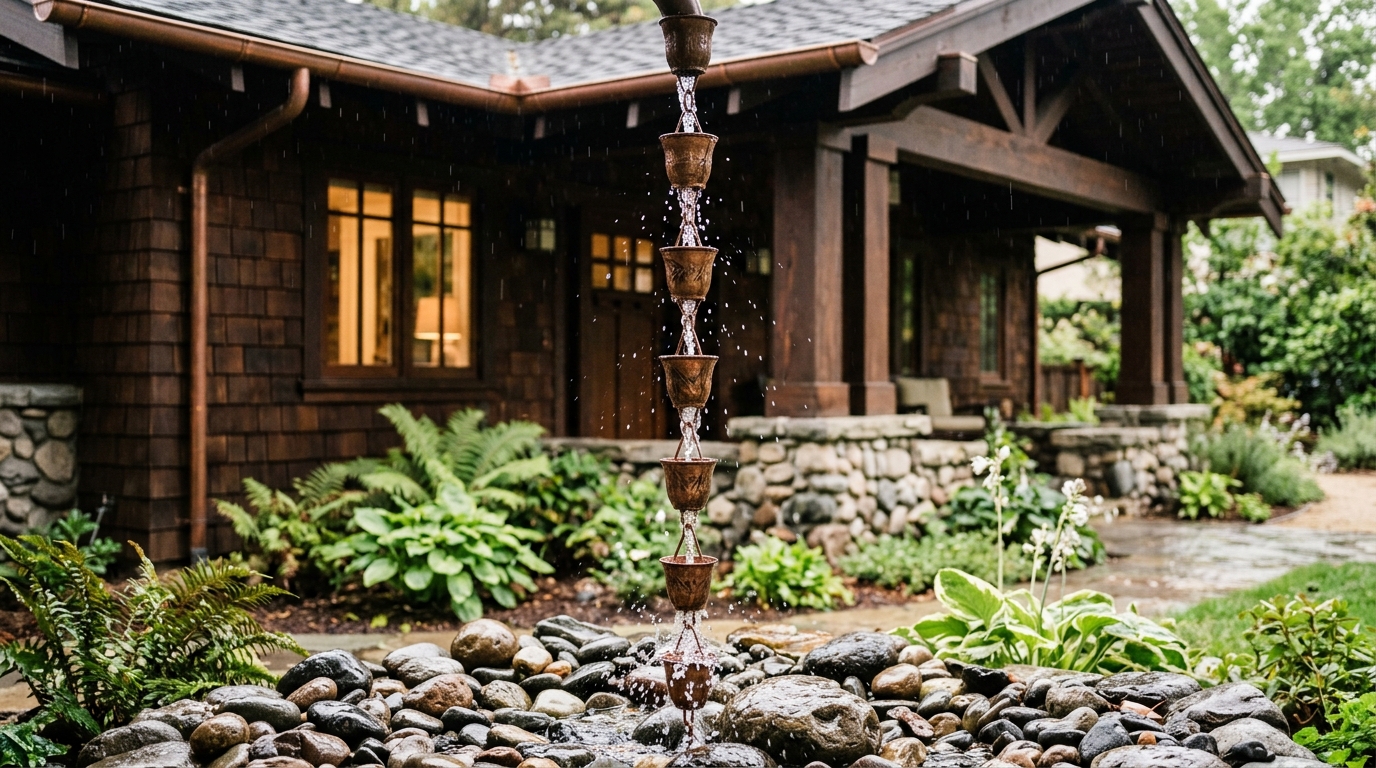
TL;DR — Rain Chain vs Downspout
For most Rocklin homes, downspouts win. A 3x4 inch downspout is rated for about 5,760 square feet of Sacramento roof in a 10-year storm (Berger's SMACNA-based table); a rain chain sheds water off its cups long before that. In a winter atmospheric river, that gap matters. Rain chains are a smart decorative downspout alternative on porches, sheds, and small accent roofs — but only when paired with a proper basin, dry creek bed, or rain barrel to protect Rocklin's expansive clay soils. Use them as a feature, not as your primary drainage system.
The rain chain vs downspout debate comes up every spring in Rocklin, usually after a homeowner sees a beautiful copper chain on a Pinterest board or a Granite Bay custom home. The appeal is obvious: instead of a boxy aluminum downspout, water spirals down a sculptural element that turns a storm into a small piece of garden art.
The catch is hydraulics. Rocklin sits on the western edge of the Sierra foothills, where atmospheric river storms can dump 2–4 inches of rain in a single day. The National Weather Service Sacramento office recorded 7+ inches over a 72-hour stretch in Placer County during the January 2023 storms. That kind of rainfall pushes most decorative drainage past its limits.
This guide walks through where rain chains genuinely work in Rocklin, where they fail, and how to use them without setting up your foundation, fascia, or landscaping for damage.
Rain Chain vs Downspout: Side-by-Side Comparison
| Feature | Rain Chain | Downspout |
|---|---|---|
| Water capacity | Not rated; sheds water in heavy bursts | 3x4: 12 sq in, about 5,760 sq ft of roof (10-yr storm) |
| Cost per drop installed | $200–$700 | $60–$180 |
| Heavy rain performance | Sheds water in storms | Handles atmospheric rivers |
| Wind resistance | Sways and splashes in wind | Fixed, no movement |
| Foundation protection | Only with basin + drainage | Easy with extensions |
| HOA compatibility | Often requires approval | Standard, pre-approved |
| Curb appeal | High — sculptural feature | Functional, color-matched |
| Maintenance | Inspect basin, clear debris | Annual flush, check elbows |
| Ice / freeze risk | Low in Rocklin (rare freezes) | Low in Rocklin |
| Best for | Porches, sheds, accents | Primary roof drainage |
Why Hydraulic Capacity Matters in Placer County
Here is the math most rain chain articles skip. Berger Building Products' sizing guide converts rain to flow: 96.15 square feet of roof in 1 inch per hour of rain produces 1 gallon per minute. Take a 2,000 square foot roof split across four downspouts, 500 square feet each. In a steady 0.5-inch-per-hour rain, each outlet carries about 2.6 gallons per minute, or 156 gallons per hour. A 3x4 inch downspout handles that easily.
In a short atmospheric river burst at NOAA Atlas 14's 10-year, 5-minute intensity for Rocklin, 2.28 inches per hour, the same outlet carries about 11.9 gallons per minute, or 711 gallons per hour. Still well within a 3x4 downspout. But a cup-style rain chain starts shedding water sideways long before that, splashing the wall, fascia, and foundation.
Rocklin Rainfall Reality Check
Rocklin averages 23 inches of annual rainfall, with 80% falling between November and March. Most of that arrives in 6–10 concentrated storm events. Your drainage system does not need to handle the average — it needs to handle the worst storm of the season without overflowing. That is the test rain chains often fail.
Where Rain Chains Actually Work in Rocklin
Rain chains are not a bad product — they are a misapplied product. Used in the right spots, they look beautiful and drain effectively. Here are the locations where we install them for Rocklin clients without hesitation.
Smart Rain Chain Locations
- Front porch overhangs: Small roof areas (under 200 sq ft) draining a single short gutter run. Low water volume, high visibility, ideal for a copper feature.
- Bay window roofs: Tiny bump-out roofs that historically collect just enough water to be annoying. A rain chain handles the volume and adds character.
- Detached sheds and ADUs: Pool houses, garden sheds, and accessory dwellings with limited roof area. Many Rocklin ADUs work well with rain chain drainage routed to a rain barrel.
- Pergolas and patio covers: If your Rocklin patio cover has a gutter, a rain chain dropping into a planted bed or dry creek is far prettier than a downspout.
- Garden focal points: A side-yard rain chain feeding a Japanese-style basin can become a meditation feature. Works because it's designed as art first, drainage second.
- Backup decorative drops: Pair a rain chain with an existing downspout system as visual relief on a long blank wall.
Where Rain Chains Fail in Rocklin
- Two-story main roofs: Too much water, too much fall distance, too much wind exposure. The chain becomes a sprinkler in any real storm.
- North-facing walls under oak trees: Oak debris clogs the cup style chains and the gutter outlet they hang from. See our best gutter guards for oak trees guide for context on Placer County's oak tannin problem.
- Foundations on expansive clay: Rocklin's clay soils swell and shrink with moisture. Dropping concentrated water at the foundation without proper extension routing is asking for slab cracking and crawl space moisture.
- Tile roof valleys: Tile roofs concentrate water at valley downspouts. Volume is too high for any chain.
- Walls with stucco or fragile siding: Wind-driven splash from a chain can stain stucco and rot wood siding within a few seasons.
- HOA street-facing elevations: Most Rocklin and Roseville HOAs require architectural review for any visible exterior change.
Cost Comparison: Rain Chain vs Downspout in Rocklin
A typical Rocklin home with 6 drops would cost $450–$1,170 to fit with traditional aluminum downspouts versus $1,350–$4,560 for a full rain chain conversion — and that assumes the chains can actually handle the roof volume, which on a two-story home they cannot.
For broader pricing context, see our downspout repair and replacement guide and gutter installation cost in Rocklin.
Foundation Protection: The Hidden Risk
This is the part that gets glossed over in most decorative downspout alternative pitches. A rain chain by itself drops water vertically, right at the base of the wall. On Rocklin's expansive clay and decomposed granite soils, that's the worst possible place for it.
Clay soils swell when wet and shrink when dry. Concentrated water at the foundation accelerates that cycle and can crack slabs, tilt sidewalks, and push moisture into crawl spaces. We cover the soil mechanics in detail in our clay soil foundation drainage and decomposed granite drainage guides.
A standard downspout solves this with a $20 extension that routes water 4–6 feet away from the foundation. A rain chain needs a more elaborate solution to do the same job:
- Catch basin: A heavy stone, ceramic, or metal basin sized for the chain's flow rate.
- Subsurface drain: A French drain or pipe routing water from the basin away from the house.
- Dry creek bed: A landscaped channel of river rock that visually carries water across the yard.
- Rain barrel: A 50–100 gallon barrel with overflow piping — popular but limited capacity.
In other words, the rain chain itself is only half the system. The drainage at the bottom is what actually protects your home. For ideas on landscaped drainage features, see downspout landscaping ideas for Rocklin homes.
Pro Tip
If you want the rain chain look without the hydraulic risk, install a rain chain on one decorative drop — usually a front porch or entry — and keep traditional downspouts on every other drop. You get the curb appeal where it matters and the storm protection everywhere else. We do this on roughly 80% of our Rocklin rain chain projects.
HOA Considerations in Rocklin and Roseville
If you live in Stanford Ranch, Whitney Ranch, Whitney Oaks, Sunset West, Clover Valley, or any of the West Roseville master-planned communities, you almost certainly have an architectural review committee. Replacing a downspout with a rain chain is technically a visible exterior modification.
Common HOA outcomes we've seen for Rocklin and Roseville rain chain requests:
- Approved on rear/side elevations only: The most common ruling. You can have a rain chain in the backyard but not on the street-facing front of the house.
- Approved with material restrictions: Copper allowed, painted aluminum allowed, plastic or brightly colored chains denied.
- Conditional approval: Approved only if paired with a permanent basin and drainage routing, not bare ground.
- Denied outright: Less common, but happens in stricter HOAs that require all visible drainage to match the home's pre-approved spec sheet.
Before ordering anything, read our HOA gutter rules for Rocklin and Roseville planned communities and submit an architectural request. The approval process usually takes 2–4 weeks.
Rain Chain Materials and Styles for California Homes
If you've decided a rain chain makes sense for at least one drop on your Rocklin home, the next decision is material and style. Here's how the options compare for California climates.
Copper Rain Chains
Cost: $150–$400
Lifespan: 50+ years
Develops a green patina over 7–15 years in Rocklin's dry climate. Pairs naturally with copper gutters — see our copper vs aluminum gutters comparison.
Brass Rain Chains
Cost: $120–$300
Lifespan: 30–50 years
Slightly less expensive than copper. Ages to a darker bronze tone. Good middle option for premium look without copper pricing.
Aluminum Rain Chains
Cost: $40–$120
Lifespan: 15–25 years
Budget-friendly, available in painted finishes to match aluminum gutters. Lighter weight means more wind movement, which can cause splash issues.
Stainless Steel Rain Chains
Cost: $80–$200
Lifespan: 30–40 years
Modern, contemporary look that doesn't patina. Pairs well with WUI-compliant ember-resistant gutter designs — relevant in Placer County's fire hazard severity zones.
Cup Style vs Link Style: Capacity Matters
Within rain chains there are two basic designs, and the difference matters more than most homeowners realize.
- Cup style: A series of small open cups stacked vertically. The cups slow water and create the characteristic cascade look. Carries the least water of any option. Best for low-volume drops.
- Link style (loop chain): A simple chain of loops without cups. Water clings to the chain by surface tension. Carries somewhat more water than cups, with less visual drama. Better for slightly larger roof areas.
Neither comes close to a standard 3x4 inch rectangular downspout. If your roof drop needs that much flow, no rain chain will keep up during a Placer County winter storm.
The Verdict: When to Choose Each
Choose a downspout when:
- The drop serves a primary roof area larger than 200 square feet
- You live on a hillside or sloped lot where runoff matters — see hillside gutter drainage
- The wall behind it is stucco, EIFS, or fragile siding that splash will damage
- Your HOA requires matching exterior drainage
- The drop is on a two-story section with significant fall distance
- You need to route water more than 4 feet from the foundation
- Budget is a concern — downspouts cost a fraction of rain chains installed
Choose a rain chain when:
- The drop serves a small accent roof — porch, bay window, shed, ADU
- You want a sculptural feature in a garden focal area
- You can pair it with a proper basin, dry creek bed, or rain barrel
- The location is sheltered from wind so the chain doesn't sway and splash
- Your HOA approves it (verify in writing first)
- You have at least one downspout drop on the same wall handling the heavy lifting
- You're in a custom home neighborhood — Granite Bay, Loomis, Auburn rural — where copper accents fit the architecture
For most Rocklin homes the answer is "both, in the right places." A traditional downspout system handles the storm water, and one or two rain chains add character at the front entry or a backyard focal point.
A Real Rocklin Example
We installed a hybrid system on a Whitney Ranch home in Rocklin last spring. The homeowners wanted the rain chain look but had been burned by a previous attempt where water blasted their dining room window during a storm. We kept the original 6 aluminum downspouts on the main roof and added one 8-foot copper cup chain on the front porch — a 90 square foot roof section dropping into a granite basin filled with river rock and connected to a 4-inch French drain routed to the side yard.
During the December 2025 atmospheric river that dumped 5 inches on Placer County over 3 days, the system worked exactly as designed. The downspouts handled the volume, and the rain chain became the visual centerpiece the homeowners had wanted — without putting their foundation or fascia at risk. Total cost for the rain chain feature: $620.
Frequently Asked Questions
Are rain chains a good idea in California?
Rain chains work in California for light to moderate rain on small roof sections — porches, bay windows, sheds, and accent areas. They struggle during atmospheric river storms, when a 500 square foot roof section can shed about 700 gallons an hour in a 10-year burst. For primary roof drainage in Placer County, downspouts are the safer choice.
Can a rain chain replace a downspout?
A rain chain can replace a downspout on small, low-volume roof sections only. For main roof areas larger than about 200 square feet, a rain chain cannot move water fast enough during heavy Rocklin winter storms and water will overshoot the chain, splash the foundation, or back up the gutter.
How much water can a rain chain handle compared to a downspout?
A standard 3x4 inch downspout has 12 square inches of cross-section, which Berger Building Products' SMACNA-based table rates for about 5,760 square feet of Sacramento roof in a 10-year storm. Rain chains carry no such rating, and in heavy rain water sheds off the cups and splashes the wall. That gap matters during Rocklin's December and January atmospheric river storms.
Do rain chains protect your foundation?
Only if paired with proper drainage at the bottom — a rain basin, dry creek bed, French drain, or rain barrel. By themselves, rain chains drop water directly at the foundation, which is actually worse for Rocklin's expansive clay soils than a downspout with a 4 to 6 foot extension routing water away.
Are rain chains allowed by HOAs in Rocklin and Roseville?
It depends on the HOA. Stanford Ranch, Whitney Oaks, and Whitney Ranch architectural review boards typically require approval for any visible exterior change including replacing a downspout with a rain chain. Some HOAs allow rain chains in rear or side yards but prohibit them on street-facing elevations.
How much does a rain chain cost installed in Rocklin?
Rain chains run $40 to $300 for the chain itself depending on material (aluminum, copper, brass) and length. Professional installation including a gutter outlet adapter, basin or splash block, and drainage routing typically runs $150 to $400 per chain location in Rocklin. Total project cost ranges from $200 to $700 per drop.
Thinking About a Rain Chain for Your Rocklin Home?
Rocklin Gutter Guard installs hybrid rain chain and downspout systems throughout Rocklin, Roseville, Granite Bay, Loomis, and Placer County. We'll walk your roof, calculate the actual flow per drop, and tell you honestly which drops can support a rain chain — and which need to stay traditional downspouts.
Free estimates • Serving Rocklin, Roseville, Lincoln, Granite Bay, and all of Placer County
Related articles:
- Gutter Alternatives for Rocklin Homes: Rain Chains, Drip Paths & Drainage
- Downspout Repair & Replacement in Rocklin CA
- Downspout Landscaping Ideas for Rocklin Homes
- Clay Soil Foundation Drainage Rocklin CA
- Atmospheric River Gutter Prep: Placer County
- HOA Gutter Rules Rocklin & Roseville
- Rainwater Harvesting Gutters California